Comparing MTL vs LTM Documentation for BCBAs
Compare MTL vs LTM prompting documentation for BCBAs. Discover errorless teaching methods, fading procedures, ethical guidelines, and decision trees to minimize prompt dependence.

By Praxis Notes Team Editorial team
Published 7 min read
On this page
In the demanding field of Applied Behavior Analysis (ABA), Board Certified Behavior Analysts (BCBAs) often grapple with key choices on prompting strategies. These decisions shape client outcomes and session flow. Selecting between most-to-least (MTL) and least-to-most (LTM) prompting calls for balancing error reduction, skill independence, and solid MTL vs LTM documentation to align with BACB guidelines. Strong documentation eases compliance, cuts paperwork, and fuels data-based changes.
This guide dives into these methods for BCBAs, rooted in proven practices. It covers prompting basics in ABA, a close look at MTL and LTM differences, tailored documentation for each, a selection framework, and fading ethics. You’ll gain practical steps to refine skill acquisition plans (SAPs) and boost client self-reliance.
Key takeaways to start:
- MTL minimizes errors from the outset, suiting sensitive learners, while LTM builds early tries for discrimination tasks.
- Documentation for both tracks prompts, responses, and fading to meet BACB standards and prevent dependency.
- Baseline data guides selection: Low independence favors MTL; higher levels suit LTM probes.
- Ethical fading demands individualized plans, with regular reviews to ensure progress without harm.
- Tools like data sheets simplify MTL vs LTM documentation, supporting team consistency.
Understanding Prompting Procedures in ABA
Prompting lies at the heart of skill building in ABA, especially for clients with autism or developmental needs. It offers short-term help to steer correct actions, matching BACB Task List rules on response prompts and fading. BCBAs directing Registered Behavior Technicians (RBTs) must pick and record prompts to keep work ethical, trackable, and client-specific.
As per the Behavior Analyst Certification Board (BACB) (2022), use stimulus and response prompts—like errorless learning, MTL, and LTM—then fade them steadily to shift control to natural signals. It’s vital to avoid prompt reliance and encourage lasting independence. Studies stress clear baseline data to spot prompt needs, so each session aids tracking.
Prompting ties into core ABA ideas, such as reinforcement and error fixes. Train RBTs for steady use, since inconsistencies muddle results. Key types include verbal cues, gestural hints, physical help, and visual aids. These fit BACB Task List G-4 on fading, like time delay or graduated guidance. They’re great for discrete trial training (DTT) or natural environment teaching (NET), tweaking for task demands. Client focus stays central, adapting to individual profiles.
Comparing Most-to-Least and Least-to-Most Prompting
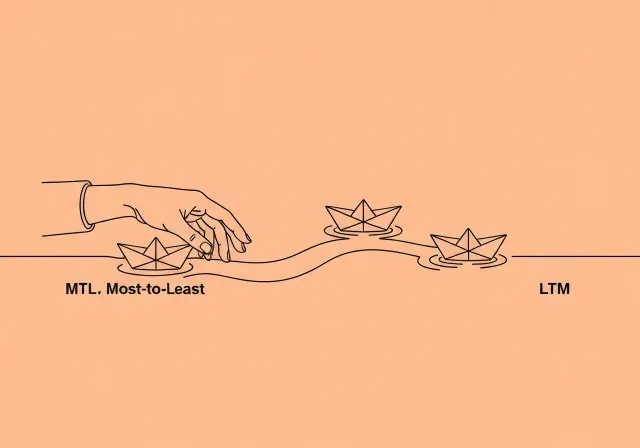
Most-to-least (MTL) prompting kicks off with top support, like full physical help, then eases back as success builds—it’s all about errorless teaching. Least-to-most (LTM), on the other hand, begins light, say with a verbal nudge, and ramps up only on misses or no response. This MTL vs LTM documentation comparison spotlights shifts in errors, speed, and BCBA logging needs.
Research indicates MTL leads to fewer acquisition errors than LTM, as detailed in a study on play skills with children with autism (A Comparison of Most-to-Least and Least-to-Most Prompting on the Acquisition of Play Skills with Children with Autism). For example, a Journal of Applied Behavior Analysis piece showed MTL as more effective for three participants gaining leisure skills, thanks to full upfront aid and cut errors (Comparison of Prompting Hierarchies on the Acquisition of Leisure Skills). Yet LTM can speed independence for some by pushing solo efforts early, despite more starting errors.
MTL logging follows fading steps trial by trial—simple in sheets but needs fading reasons. LTM captures error trends and ramps, adding depth for review. MTL works best for error-shy clients; LTM for those honing choices. BACB (2022) calls for personalization to dodge dependency (BACB Ethics Code).
| Aspect | MTL Prompting | LTM Prompting |
|---|---|---|
| Error Rate | Lower (errorless approach) | Higher at first |
| Acquisition Speed | Steady but often slower | Can quicken independence |
| Documentation | Fading sequence logs | Error and ramp details |
| Best For | Learners avoiding frustration | Building choice skills |
A 2021 study on expressive tasks backs MTL for error cuts but flags learner variations (A comparison of most to least prompting, no-no prompting, and responsive prompt delay procedures). BCBAs, test both in baselines for the right match. This setup aids MTL vs LTM documentation by highlighting fit factors early.
Documentation Best Practices for MTL Prompting
MTL pairs with errorless teaching documentation, aiming for full early wins via max aid before easing off. In the SAP, BCBAs outline hierarchies and mastery, like 80% independence over three sessions (ABA Prompt Fading: Procedures, Examples & Best Practices). Sheets note trial starts, rights, and drops to show gains.
ABAI guidelines call for logging reinforcement right after prompted successes, blocking error boosts (Errorless Learning: Complete Guide - Master ABA). Add notes on engagement and tweaks, such as time delays for better flow. Use ABA templates for secure, easy entry under HIPAA.
Justify MTL in SAPs with client background, like error dislikes. Log fading numbers: Drop after 3-5 straight wins at level (How to Fade Prompts in ABA). For 90% accuracy before cuts, revert on over 10% errors (Understanding Prompting Strategies in ABA Therapy).
Essential logs cover date, skill, prompt (full physical to gesture), trials, and independence rate. Watch for quick over-fades—note slips to tweak. Digital sheets with graphs help spot trends fast. This rigor aids audits and team shares. A 2016 NIH study noted MTL’s light error load with clear setups (Comparison of Prompting Hierarchies).
Documentation Best Practices for LTM Prompting
LTM stresses prompt fading procedures from light to heavy, logging errors as growth chances. SAPs spell out ramps—like verbal to physical post-error—and mastery, such as zero low-prompt errors over three sessions (ABA Prompting Hierarchies: Least-to-Most Prompting). Focus sheets on solo tries for autonomy tracking.
BACB standards (2022) require latency and error logs in LTM, given early misses need pattern checks (BCBA Task List (5th ed.)). Notes cover ramp reasons, partial reward, and fade plans to curb reliance. Tie to reports showing independence rises.
LTM amps detail over MTL due to shifting paths, but spotlights toughness. Back LTM choice with baselines for discrimination needs.
Core elements include prompts per trial, errors by level, ramp time, and rewards. Advance on 80% no-ramp success; log stalls (How to Fade Prompts Effectively in ABA). Checklists keep things even; weekly scans adjust for excess aid. In NET, note settings for real fade. A 2020 USF work praised LTM logs for quicker self-reliance amid error notes (Assessing Prompting Strategies). Solid MTL vs LTM documentation here ensures ethical depth.
Decision-Making Guide for BCBAs: MTL vs. LTM Selection
Use a step-by-step tree for MTL vs LTM picks, led by client eval. Check error handling first: Go MTL for low-frustration folks or error-linked behaviors, fitting errorless paths. For quick self-skills on known tasks, try LTM to spark choices soon.
Task and profile guide next. MTL aids chains like dressing without half-errors; LTM fits basic picks via try-outs. Baseline check: Under 20% independence? MTL start. Over 40%? LTM test (A Comparison of Most-to-Least and Least-to-Most Prompting on the Acquisition of Play Skills with Children with Autism). ABAI suggests short pilots for both, logging results for SAP input (A Decision-Making Tool for Evaluating and Selecting Prompting Strategies).
Fade ethics fit in—MTL slower (3-5 wins) vs. LTM (post-error win) (The Role of Prompting and Fading in Skill Development). Short sessions lean MTL. Step 1: Gauge needs—error feel? Task depth? Step 2: Baseline both; weigh errors and speed. Step 3: Log reasons per BACB G-4; add mastery. Step 4: Weekly checks; swap on stalls. A 2008 Libby study favored MTL efficiency but stressed personal fits (A Comparison of Prompt-Fading Strategies).
Ethical Considerations in MTL vs LTM Documentation for Prompt Fading
Fading prompts demands BACB Ethics Code duties, focusing on self-rule and no harm by cutting reliance. Plans must data-drive reductions, not set times, to honor dignity. Section 4.02 pushes custom setups, logging how MTL vs LTM choices fit client aims and backgrounds (BACB Ethics Code).
Spot over-prompts that sap confidence. Ethics mean family talks on fade risks, like brief dips. BACB (2022) urges team work for fading skills.
Equity matters: Adapt for varied learners, skipping error guesses. On dependence, log fixes like delays. A 2021 Behavioral Interventions piece stressed ethical fading for outcomes (Prompts, Prompt Fading Strategies).
Core duties: Tailor fades; get consent; watch harm. Red flags: Flat independence—back up and review. Best guard: Audits; RBT ethics training. MTL vs LTM documentation strengthens these by tying ethics to data.
Frequently Asked Questions
How do error rates compare between MTL and LTM prompting?
MTL cuts errors via full starts, ensuring early rights, per a 2016 NIH leisure study showing less than LTM (Comparison of Prompting Hierarchies). LTM permits starting errors for self-growth, but it may upset fragile clients. Baseline both; log for ethical tweaks.
What are the main advantages of using MTL prompting?
MTL shines in error cuts, matching errorless teaching for confidence, under BACB G-4 (BCBA Task List). It streamlines complex tasks with quick aid. Logs stress success fades over error digs, but watch for extra dependence.
When is LTM prompting more effective than MTL?
LTM aids fast discrimination for higher-function clients or routines, per a 2021 expressive study (A comparison of most to least prompting, no-no prompting, and responsive prompt delay procedures). Log errors tight to guard progress.
How do you determine the right time to start fading prompts in ABA?
Start on steady wins at level, like 80-90% over 3-5 trials, via ABAI practices (Best Practices - Association for Behavior Analysis International). Follow data, not clocks. Revert on error spikes; log shifts for client focus.
What are common mistakes in prompt fading documentation?
Skipping error trends or fast fades without rules breeds reliance, against BACB ethics (2022) (Ethics Code). RBT variances twist data. Set SAP measures; train for match.
How can BCBAs prevent prompt dependency ethically?
Fade data-led, with delays, and track dips per BACB 1.02 (BCBA Handbook). Loop in families; plan-justify choices. This guards self-rule sans hurt.
Mastering MTL vs LTM documentation lets BCBAs craft sharp, ethical ABA plans for true independence. Weigh errors, fit logs, and use trees to cut risks like reliance while hitting BACB marks. Studies highlight MTL’s errorless win for many, LTM’s self-push—always custom.
Audit SAPs for fade rules next, probe-train RBTs on both, and add digital logs. This boosts compliance, lifts results, and upholds ABA’s data-driven core. Check Praxis Notes’ AI templates for workflow ease.