ABA Progress Report Template: Free PDF, Filled Example and How to Read One
Free ABA progress report template (PDF, no sign-up) with goals by domain, baseline, current and mastery columns, a filled 6-month example and payer rules.

By Praxis Notes Team Editorial team
Updated 12 min read

On this page
An ABA progress report shows how a client changed during one authorization period, often six months (Florida Medicaid requires a reassessment “at least every six months”). It lists each goal by domain with baseline, current level and mastery criterion, graphs the data, explains barriers and hours delivered, and recommends next steps. Our free template below covers every section.
Free download, no sign-up: a printable three-page template with a filled fictional example, plus an editable Word version you can type into. Download the ABA progress report template (PDF) or download the editable template (DOCX).
The template is written for BCBAs and clinic staff who write the report, and the page is part of our Family Resources because families read these reports too. If you are a parent trying to make sense of one, skip to how parents can read an ABA progress report. This page is general information, not billing or legal advice: your payer’s own form and policy always win.
What goes in an ABA progress report?
Our template uses ten sections: identifying information, services delivered, assessments, goal progress by domain, graphs, a progress summary with barriers, generalization, medical necessity and recommendations, coordination of care, and signatures. The table shows what the template asks for in each section and the payer or ethics rule behind it.
| # | Section | Fields in the template | Why it is there |
|---|---|---|---|
| 1 | Identifying information | Client initials or ID, age, diagnosis code, payer, authorization number, report type (6-month, 3-month, discharge), reporting period, report date, setting, lead BCBA and certification number, provider or agency | Ties the report to one authorization period. The template uses initials or an ID; add the identifiers your payer requires only on the copy you submit. |
| 2 | Services this period | Hours authorized, hours delivered, % of authorized hours delivered, reasons for missed sessions, caregiver training sessions, supervision hours | Optum’s ABA criteria (policy BH803ABASCC082025, interim review April 2026) say reviewers will address use of authorized hours “below 80% over a 2-week period,” with documentation of barriers and how they are addressed. |
| 3 | Standardized and curriculum assessments | Tool, dates, previous score, current score, change, notes on results | Optum lists “change scores for any outcome measures, updated standardized adaptive measures, and change scores for skills-based assessments” as part of progress. |
| 4 | Goal progress by domain | Domain, goal, measure, baseline (date), current, mastery criterion, status (met, not met, modified) | The Florida Medicaid Behavior Analysis Services Coverage Policy (December 2024) requires baseline, mastery criteria and “statements as to whether goal or objective is met; not met; or, modified (with explanation)” for each goal. |
| 5 | Graphs | One graph per target, with phase-change lines and the mastery criterion drawn as a line | Florida Medicaid: “Each behavior under treatment must have its own data table and corresponding graph.” BACB Ethics Code 2.17 also requires behavior analysts to “graphically display, summarize, and use the data.” |
| 6 | Progress summary and barriers | Plain-language summary, barriers and the plan for each | Florida Medicaid asks for “a narrative discussion of progress”; Optum asks for barriers “and corresponding solutions.” |
| 7 | Generalization and maintenance | Skills seen across people, settings and materials; skills in maintenance | Optum asks how “generalization and maintenance are targeted across the individual’s environments.” |
| 8 | Medical necessity and recommendations | Why treatment at this intensity is needed, hours requested by service, goals added or changed, transition and discharge plan | Florida Medicaid requires “a statement of justification for continuation of care at the intensity level requested” and a transition (fading) plan. |
| 9 | Coordination of care | School or IEP, physicians, speech or occupational therapy, other providers | Both Optum and Florida Medicaid list coordination with schools and other providers. |
| 10 | Signatures | BCBA signature, credential and date; caregiver signature and date | Florida Medicaid requires the plan to be “signed by the Lead Analyst and the recipient’s parent or guardian.” |
Not every payer asks for all ten, and some add their own fields. Keeping all ten in one template means you only delete what a payer does not want.
How do you fill in the goal table?
Write each goal row so a reviewer can see the change without reading anything else. Optum’s criteria require progress to be measured with “the same modes of measurement that were utilized for baseline,” so a goal with a baseline in requests per hour must report its current level in requests per hour, not as a percentage.
For each row:
- Domain. Group goals by communication, social or play, adaptive or daily living, behavior reduction and caregiver training. Add rows when a domain has more than one target.
- Goal. Name the behavior in observable terms and the condition: “Returns a peer greeting within 5 seconds,” not “improve social skills.” Our guide to writing measurable ABA goals covers the wording.
- Measure. The unit: rate per hour, % of opportunities, steps of a task analysis done independently, or % fidelity for caregiver goals.
- Baseline (date). The level before teaching started, with the month it was measured. See how to document baseline data.
- Current. The level at the end of the period, in the same unit. Say how you summarized it (the last probe, or a mean of the last three sessions) and use the same rule for every goal.
- Mastery criterion. The level, how many sessions in a row, and across which people or settings, as written in the treatment plan.
- Status. Met, not met, continue or modified, with a short reason. When a goal is met, name the goal that replaces it or say it moved to maintenance.
ABA progress report example (filled, fictional)
The example below is a 6-month reassessment report for a fictional 5-year-old, “J.R.”, in clinic and home treatment. Figure 1 shows an excerpt of the filled example (identifying information, goal table and graph); the full three-page example is pages 4 to 6 of the PDF. Every name, number and score in it is made up.
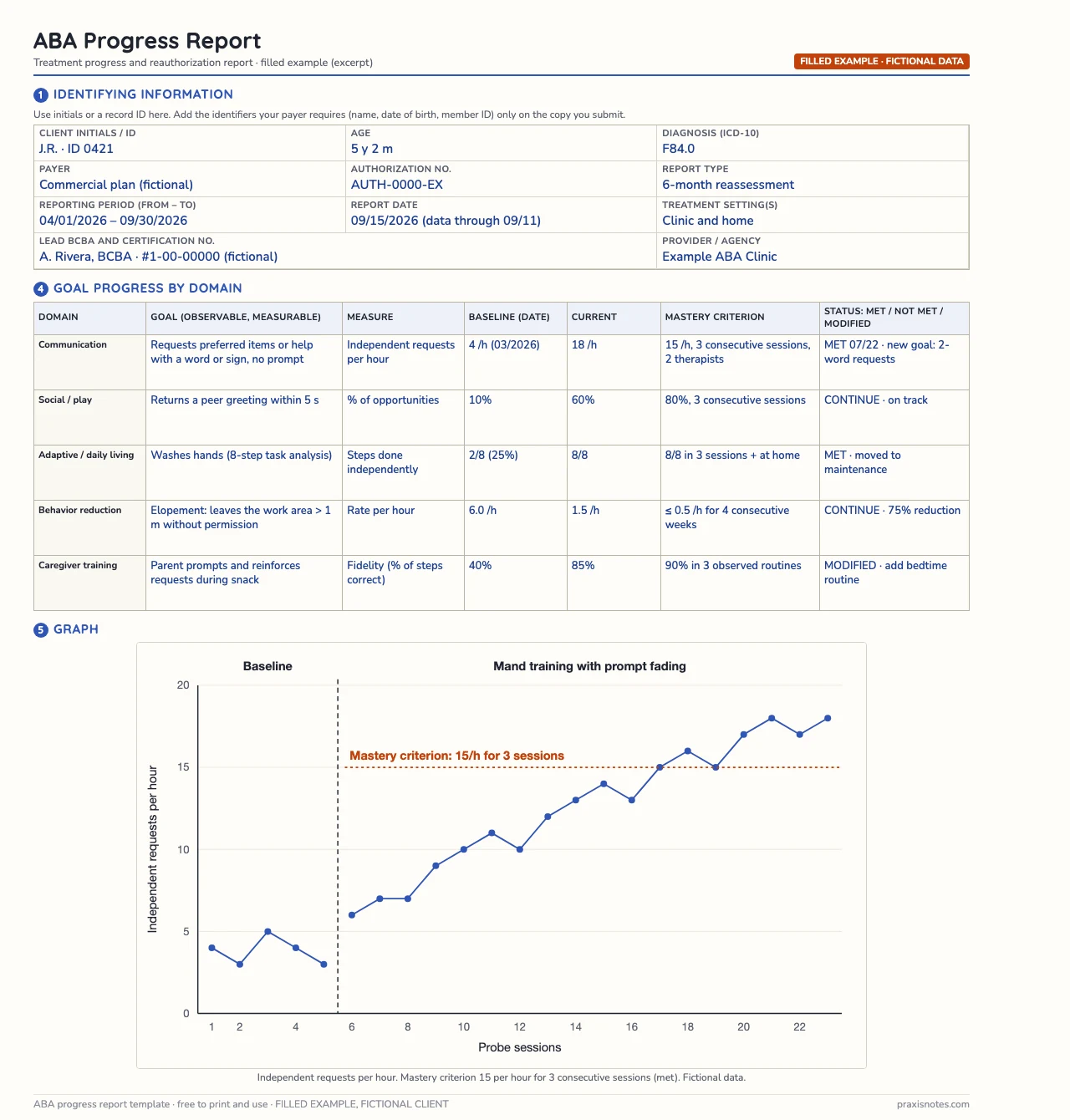
The goal table from the example, as text:
| Domain | Goal | Measure | Baseline | Current | Mastery criterion | Status |
|---|---|---|---|---|---|---|
| Communication | Requests preferred items or help with a word or sign, no prompt | Independent requests per hour | 4/h (03/2026) | 18/h | 15/h for 3 consecutive sessions, 2 therapists | Met; new goal: 2-word requests |
| Social / play | Returns a peer greeting within 5 s | % of opportunities | 10% | 60% | 80% for 3 consecutive sessions | Continue; on track |
| Adaptive | Washes hands (8-step task analysis) | Steps done independently | 2/8 | 8/8 | 8/8 in 3 sessions and at home | Met; moved to maintenance |
| Behavior reduction | Elopement: leaves the work area by more than 1 m without permission | Rate per hour | 6.0/h | 1.5/h | 0.5/h or less for 4 consecutive weeks | Continue; 75% reduction |
| Caregiver training | Parent prompts and reinforces requests during snack | Fidelity (% of steps) | 40% | 85% | 90% in 3 observed routines | Modified; add bedtime routine |
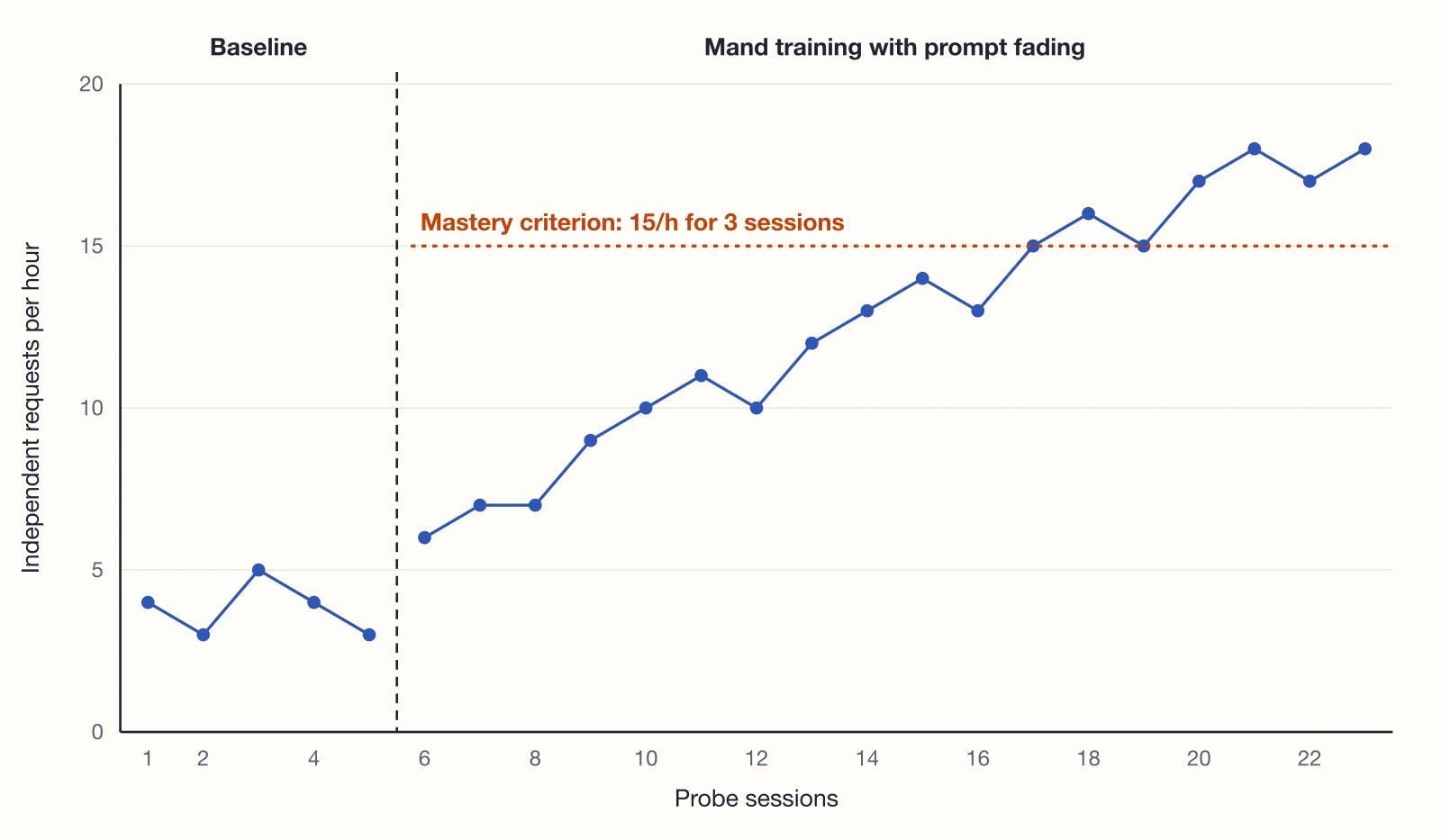
Figure 2 is the graph behind the communication row. Requests stayed between 3 and 5 per hour in baseline, rose steadily once mand training started, and met the criterion of 15 per hour for three sessions in a row at sessions 17 to 19. The latest probe, 18 per hour, is the current level in the table.
The rest of the example, condensed:
- Services: 20 hours a week authorized, 15.6 delivered on average (78%). Missed hours came from three weeks of illness and a one-week family trip, with no staffing gaps. Make-up sessions were offered on Saturdays.
- Assessments: VB-MAPP milestones 52 to 78; Vineland-3 Adaptive Behavior Composite 68 to 73; caregiver fidelity checklist (snack routine) 40% to 85%.
- Summary: “J.R. met 2 of 5 goals. Independent requests rose from 4 to 18 per hour and generalized to home snack time. Elopement fell 75%; it now occurs mainly during transitions from preferred play.”
- Recommendation: continue 20 hours a week of direct treatment and 2 hours of supervision for six months, because elopement still interrupts group learning and peer greetings remain below the level a kindergarten classroom needs. Add 2-word requests and waiting up to 2 minutes; fade to 15 hours once elopement stays at 0.5 per hour or less for four weeks.
- Signatures: report dated 09/15/2026 with data through 09/11, two weeks before the authorization ends; BCBA signed 09/15/2026 and the caregiver 09/16/2026 after a review meeting.
What do payers require in an ABA progress report?
Payers ask for the same core: measurable goals with baseline and current data, graphs, a narrative, barriers, caregiver involvement and a justification for the hours requested. The details and deadlines differ, so check your payer’s policy and any form it publishes before you submit. Three published examples, checked on 2026-11-08:
| Source | What it asks for | Timing |
|---|---|---|
| Optum Supplemental Clinical Criteria, ABA (interim review April 2026) | Progress “for each targeted symptom and behavior,” in the baseline’s unit; mastered programs and targets; change scores on standardized and skills-based assessments; caregiver involvement; barriers and solutions; goals reconsidered; transition to less intensive care when goals are met and ABA is no longer clinically appropriate | “Treatment plans are usually reviewed/updated twice annually,” or per state mandate |
| Florida Medicaid Behavior Analysis Services Coverage Policy (December 2024) | A data table and graph for each behavior; met, not met or modified for each goal; a narrative; a justification for the intensity requested; signatures of the lead analyst and parent or guardian; documented efforts to involve the parent | Reassessment and updated plan “at least every six months”; core instruments every 12 months |
| Washington Medicaid, WAC 182-531A-1100 | A reevaluation and revised treatment plan “showing measurable changes in the frequency, intensity, and duration of the targeted behavior/symptoms,” plus projected outcome, assessment instruments, readiness markers and coordination with other providers | Authorized in three-month increments, “or longer at the agency’s discretion”; request “15 calendar days prior to the expiration date” |
Commercial medical policies can be much shorter. Aetna’s ABA policy (CPB 0554), last reviewed October 14, 2026, makes “continuation of services dependent on documentation of measurable improvement in targeted behaviors and functional outcomes” without listing report sections, which is one reason a full template is safer than a minimal one. For the insurance side, denial reasons and appeals, see our guide to ABA progress reports for insurance reauthorization, and for how this report differs from a letter of medical necessity, ABA progress report vs LMN.
How often is an ABA progress report due?
Most ABA progress reports are due every six months, timed to the end of each authorization period, but some payers authorize shorter periods. Florida Medicaid requires a reassessment and updated plan at least every six months; Washington Medicaid authorizes in three-month increments (or longer at the agency’s discretion) and wants the renewal request 15 calendar days before the authorization expires; Optum says plans are usually updated twice a year. Put the due date in your calendar when the authorization starts, and leave time to graph data and meet the caregiver before the deadline.
Weekly or monthly progress summaries for the treatment team are a different document. Our guide to weekly ABA progress reports covers those.
What should the report say when progress is slow?
When a goal has not moved, the report should say so plainly, give the likely reasons and describe what changes next. Florida Medicaid requires the provider to “explain why clinically significant progress was not made and treatment changes to promote progress.” Optum asks for an assessment of the reasons when there is no demonstrable progress within six months, and lists what supports continued coverage: more time on targets, changed teaching procedures, more caregiver training, barriers with solutions, new co-occurring conditions and goals that were modified or removed.
In the template, that goes in section 6 (barriers and the plan for each) and the “goals added, modified or discontinued” line in section 8. BACB Ethics Code 2.18 asks the same of behavior analysts outside of billing: “If data indicate that desired outcomes are not being realized, they actively assess the situation and take appropriate corrective action.” For wording examples, see documenting lack of progress.
What are common mistakes in ABA progress reports?
The most common gaps are the ones payer rules name directly. Check a draft against this list before it goes out:
- Current level in a different unit from baseline. Optum’s criteria want progress in “the same modes of measurement that were utilized for baseline.” A baseline in rate per hour and a current level in percent cannot be compared.
- One combined graph. Florida Medicaid requires a separate data table and graph for each behavior under treatment.
- Missed hours with no reason. Optum reviews use of authorized hours below 80% and expects the barriers and the plan to be documented.
- Goals with no status. Florida Medicaid wants every goal marked met, not met or modified, with an explanation for changes.
- A narrative that does not support the hours. The recommendation has to justify the intensity requested, not only describe progress.
- No caregiver involvement, and no reason why. Optum says that if a caregiver cannot take part, the documentation “should include the reason and identify an alternate plan”; Florida Medicaid asks providers to document their efforts to involve the parent.
- Missing signatures or dates. Florida Medicaid requires the lead analyst’s and the parent’s or guardian’s signatures on the plan.
How can parents read their child’s ABA progress report?
Start with the goal table: for each goal, compare the baseline with the current level and check the status column. A progress report for an autistic child should tell you, in plain words, which skills your child gained, which behaviors went down, what got in the way and what the BCBA recommends next. BACB Ethics Code 2.08 requires behavior analysts to “use understandable language” and to explain assessment and intervention results, so you can ask for any part to be explained.
Four things to look at:
- Baseline versus current. In the example, requests went from 4 to 18 per hour. The numbers should use the same unit, so the change is easy to see.
- The graphs. Look at the level (how high the data are), the trend (which way they are going) and the variability (how much they jump around). Our guide to level, trend and variability explains each with examples.
- Hours delivered. If fewer hours were delivered than authorized, the report should say why. Missed sessions can explain slower progress.
- Home and school. The generalization section should say whether skills show up outside therapy. Your notes from home help here; an ABC data sheet for home is one simple way to record them.
Questions worth asking at the review meeting:
- Which goals were met, and what replaces them?
- Which goals have not moved, and what will change?
- Are the skills showing up at home and school, and how was that checked?
- Why is this number of hours recommended, and when could it go down?
- What should I practice at home before the next report?
You will usually be asked to sign the report or the updated plan. Signing says you reviewed it, so ask questions first. For the rest of the paperwork you will see, our guides to ABA progress notes for parents and ABA treatment plans for parents explain each document.
Sources
- Optum. Applied Behavior Analysis (ABA) Supplemental Clinical Criteria, policy BH803ABASCC082025, annual review August 2025, interim review April 2026.
- Florida Agency for Health Care Administration. Florida Medicaid Behavior Analysis Services Coverage Policy, December 2024, sections 4.2 and 6.2.
- Washington State Legislature. WAC 182-531A-1100, subsection (4).
- Aetna. Applied Behavior Analysis, Clinical Policy Bulletin 0554.
- BACB. Ethics Code for Behavior Analysts, codes 2.08, 2.17 and 2.18.
Reviewed by the Praxis Notes team on 2026-11-09.