RBT Exam Day: Cost, What to Bring, Results and Retakes
RBT exam cost from the October 2026 BACB Handbook: $65 application, $45 per attempt, reschedule fees, a what-to-bring checklist and the retake rules.

By Praxis Notes Team Editorial team
Published 16 min read
On this page
The RBT exam costs $45 per appointment, paid to Pearson VUE, on top of the $65 application fee paid to the BACB, so passing on your first attempt costs $110 in fees plus any local tax, according to the RBT Handbook (updated October 2026, pp. 6 and 9). Each retake costs another $45.
This page is for candidates with an exam date, and for anyone who just failed. It covers every exam fee and what they add up to, what to bring, the testing-center rules, how results work, the retake timeline and a domain-by-domain recovery plan. For what to study, use the RBT exam study guide; more exam guides are in Study Guides & Exam Prep.
A one-page printable version is available: download the RBT exam day checklist (PDF). No sign-up needed.
How much does the RBT exam cost?
The RBT exam appointment costs $45 each time you sit it, and the only other BACB or Pearson VUE fee you need to reach the exam is the $65 certification application fee. These are the current amounts from the RBT Handbook (pp. 6, 9 and 10), and Pearson VUE’s BACB page (updated August 27, 2026) lists the same RBT appointment and change fees:
| Fee | Amount | Paid to | When you pay |
|---|---|---|---|
| Certification application processing, 2026 | $65 | BACB | When you submit the application |
| Exam appointment, every attempt | $45, plus any tax | Pearson VUE | When you schedule |
| Retake application | $0 at present | BACB | After a failed attempt |
| Cancel or reschedule, 31 or more days out | $0 | Pearson VUE | When you make the change |
| Cancel or reschedule, 30 to 5 days out | $27 | Pearson VUE | When you make the change |
| Cancel or reschedule, 5 days to 48 hours | $32 | Pearson VUE | When you make the change |
| Cancel or reschedule, under 48 hours | Not permitted | n/a | n/a |
Many pages still quote a $50 application fee or a $35 retake fee. The October 2026 Handbook lists $65 to apply and no retake application fee; its only $50 fees are for recertification, not for your first application (p. 29). The BACB labels the $65 as its 2026 fee, so check again if you apply in 2027.
BACB fees are nonrefundable and nontransferable, and veterans who qualify for the GI Bill can get exam fees reimbursed by the Department of Veterans Affairs whether or not they pass (RBT Handbook, p. 6). The 40-hour training and background checks are not exam fees; how to become an RBT covers the whole certification cost.
What does the RBT exam cost in each scenario?
Getting to a pass costs at least $110 in fees, application included, and $425 if you use all 8 attempts on one application, before any change fees or tax. The totals below are our arithmetic from the Handbook’s fee table:
| What happens | Fees | Total |
|---|---|---|
| Pass on the first attempt | $65 + $45 | $110 |
| Reschedule 10 days out, then pass | $65 + $45 + $27 | $137 |
| Reschedule 3 days out, then pass | $65 + $45 + $32 | $142 |
| Fail once, pass on the second attempt | $65 + $45 + $45 | $155 |
| Miss the appointment, rebook, then pass | $65 + $45 + $45 | $155 |
| Application lapses at 90 days, reapply, pass | $65 + $65 + $45 | $175 |
| Fail twice, pass on the third attempt | $65 + $45 + $45 + $45 | $200 |
| Use all 8 attempts | $65 + (8 × $45) | $425 |
Our reading: the reschedule rows assume the change fee is added to the $45 you already paid, because the Handbook describes it as a separate fee.
An application that isn’t completed within 90 days has to be resubmitted and paid for again (RBT Handbook, p. 5), which is why the BACB recommends waiting to apply until you meet every requirement.
How do you schedule the RBT exam with Pearson VUE?
You schedule the RBT exam in your Pearson VUE account after the BACB approves your application and emails you instructions; the BACB cannot book it for you (RBT Handbook, p. 9).
- Allow two weeks for the BACB to process your application (p. 6).
- Check your Authorization to Test letter before you book, and contact the BACB immediately if anything is wrong, as Pearson VUE advises.
- Pick a test center and date. You have one year from the day your application is approved to sit the exam (p. 6). Testing is available in the United States, in Canada except Quebec and Ontario, and in Australia until January 1, 2027 (p. 9).
- Pay $45 at scheduling, plus any sales tax, VAT or GST that applies (p. 9).
- Read the confirmation email in full. Pearson VUE says it arrives within 24 hours of scheduling.
- Try the Pearson VUE demo test so the screen layout is familiar (p. 10).
Check your name now, not on exam day. The name in your BACB account must match your ID exactly, and name changes need BACB staff review, which could delay your exam (p. 4). If you need accommodations, request them with your application: the review typically takes 10 to 14 days (p. 10).
What does it cost to cancel or reschedule your Pearson VUE appointment?
Changing your RBT appointment is free 31 or more days out, costs $27 from 30 to 5 days out and $32 from 5 days to 48 hours out, and isn’t allowed inside 48 hours (RBT Handbook, p. 9). Make the change in your Pearson VUE account or through its customer service; the BACB can’t do it for you.
Two things the sources leave open:
- Exactly 5 days out. Both fee windows include “5 days”, so make the change by day 6 if you want the lower fee (our reading).
- Whether canceling returns the $45. The Handbook says all fees are nonrefundable, yet also says no refund is issued inside 48 hours, which implies there may be one before that. Ask Pearson VUE before you cancel instead of rescheduling.
What do you need to bring to the RBT exam?
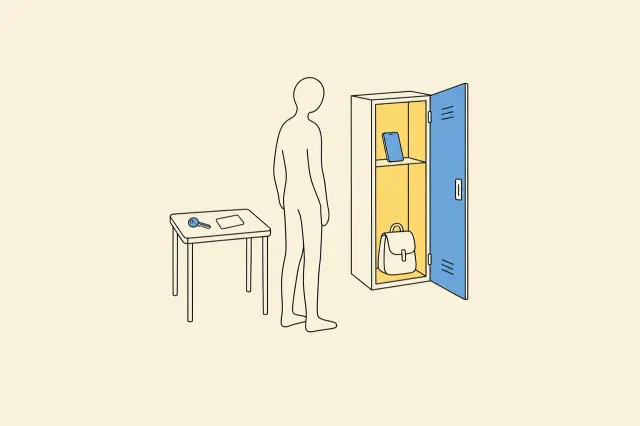
You need to bring one valid government-issued ID, and that ID and your locker key are the only things allowed into the exam area (RBT Handbook, pp. 11-12). Your ID must be:
- Government issued and original, not a photocopy or digital ID
- Current, not expired
- Signed, with a recognizable photo
- In your first and last name, exactly as it appears in your BACB account
Accepted examples are a passport, driver’s license, military ID, national, state or province ID card, and green card or visa. Any name discrepancy or invalid ID means you are turned away and all paid fees are forfeited (p. 11).
Pearson VUE’s general Global ID Policy 1 accepts an expired ID with renewal paperwork, but the RBT Handbook and Pearson VUE’s BACB page both say the ID must be current. Our reading: don’t rely on renewal paperwork. That policy also says an ID must come from the country where you test, otherwise you need a passport, and that exceptions need approval from the BACB at least five business days before your appointment.
Everything else has a place. This table combines the RBT Handbook (pp. 11-13) with Pearson VUE’s Candidate Rules Agreement (version 1.6, September 2026):
| Item | Where it goes |
|---|---|
| One valid ID, locker key | With you for the whole exam |
| Food, drink, medication | Locker; you can use them on a break, not in the room |
| Phone (turned off), watch, other electronics | Locker; off limits on breaks too |
| Bag, purse, wallet, glasses case | Locker |
| Hat, coat, jacket | Locker; religious head coverings are not included |
| Hair clips or removable jewelry over 1/4 inch wide, headbands over 1/2 inch | Locker |
| Sweater, sweatshirt, blazer, traditional garments | You can wear them |
| Pens, pencils, scratch paper, calculator, ruler | Locker or home; not allowed in the room. The center gives you a dry-erase board |
| Notes, textbooks, flashcards | Leave at home |
| Visitors, children, friends | Not allowed in the test center |
Lockers hold only a small number of items, and the center isn’t responsible for losses, so bring little. The notes row is our reading. Pearson’s rules and one Handbook line treat notes as storable, but another Handbook line bars having study materials, documents or notes at the testing center, so leaving them out of the building is the safe choice. Because a calculator isn’t allowed, practice calculating rate, mean duration and percentage by hand before the exam.
What are the rules at the RBT testing center?
At an RBT testing center you complete an ID, palm-scan and photo check-in, take only your ID and locker key into the room, and are monitored on video and audio for the 90 minutes. Arrive about 30 minutes early, because check-in includes an ID check, agreeing to the rules, a palm vein scan and a digital photograph, all in English (RBT Handbook, pp. 10-11). If you can’t complete check-in, you are turned away and lose all paid fees. Interpreters are allowed only with an approved accommodation (p. 11).
Before you enter the room, you pat yourself down, empty your pockets and allow a wand scan, and staff may ask to see your ears or have you roll up your sleeves, according to Pearson VUE’s Candidate Rules Agreement. If you need a religious or medical waiver of the photo, palm scan or wand scan, get it approved by the BACB before your appointment.
Once you are seated, these rules apply (RBT Handbook, pp. 11-13):
- Your 90 minutes includes everything. The terms and conditions, the tutorial and any review time all come out of it. Refusing the terms ends the exam and forfeits your attempt and fees.
- Breaks are unlimited, but the clock keeps running. You can use food, drink or medication on a break. You can’t use your phone, read notes or go to your car.
- Never leave the building. Doing so ends your exam and forfeits the attempt and fees.
- You are monitored by video and audio the whole time.
- Use the dry-erase board. Don’t write on it until the test has started (Candidate Rules Agreement). Every center has earplugs on request, and some have noise-canceling headphones.
- Raise your hand if something goes wrong, such as noise or a slow screen. Staff can’t answer questions about exam content (Handbook p. 13; the raise-your-hand rule is in section 14 of Pearson VUE’s Candidate Rules Agreement).
What happens if you are late or miss your RBT exam?
If you arrive more than 30 minutes late you are turned away and lose your $45, and if you don’t show up you also lose the $45 and must pay it again to rebook (RBT Handbook, p. 9). The Handbook says you can schedule the new appointment in your Pearson VUE account within 24 hours of the one you missed.
The Handbook doesn’t say whether a missed appointment counts toward your 8 attempts. Our reading is that it doesn’t, because the retake application is tied to a failed attempt and a missed appointment doesn’t require one. Confirm this with the BACB if you are near the limit.
What is the RBT exam passing score?
Neither the RBT Handbook nor the BACB’s examination information page gives a passing score: the result is pass/fail (Handbook, p. 14), and the BACB says it does not report how many questions you answered correctly. Figures such as “60 out of 75”, “80%” or “200 out of 250” do not appear in either source.
Here is how the BACB does describe it:
- A panel of BACB-certified experts sets the passing score with the modified Angoff method, and the Board of Directors approves it. The method is criterion-referenced, so your result doesn’t depend on how others do (Handbook, p. 14).
- The number of correct answers needed can vary by exam form, because forms are statistically equated to adjust for differences in difficulty (examination information page).
- A new passing score is set when the exam content changes significantly, such as a new test content outline (Handbook, p. 14). Our reading: any number from before the 3rd edition started in January 2026 describes a different exam.
- Where the BACB uses scaled scores, its page says the scales have more points than the exam has questions, so a scaled number isn’t a count of correct answers.
Because we found no published cutoff, no practice score can tell you that you’ll pass. For how often candidates do pass, see the RBT exam pass rate data.
How many questions are on the RBT exam?
The RBT exam has 85 multiple-choice questions, of which 75 are scored and 10 are unscored, with four options each and 90 minutes to answer (RBT Handbook, pp. 7 and 11). All questions are equally weighted, and the result rests on your overall performance, not on each content area. The study guide breaks the 75 down by domain.
When do you get your RBT exam results?
You get your RBT exam result at the testing center as soon as you finish, and it’s pass or fail (RBT Handbook, p. 14). For a copy, log in to your Pearson VUE account and select “View Score Reports”; the BACB can’t view or download it for you.
If you pass, the BACB emails you about your certification. The Handbook gives two timeframes for that email, “within one week” on p. 14 and “within approximately 24 hours” on p. 15, so allow a week before you ask. You should appear on the BACB Certificant Registry within about 24 hours (p. 15).
Passing doesn’t let you start work straight away. Your certification begins as inactive, and you can’t use it until the qualified RBT Supervisor or RBT Requirements Coordinator who provides your ongoing supervision adds you as a supervisee in their BACB account (p. 15). Tell them your exam date so they can do it quickly.
What happens if you fail the RBT exam?
If you fail (see RBT exam pass rates for first-time and retake candidates), you can sit the exam again after 7 days, up to 8 total attempts within 12 months of your application approval, and the BACB doesn’t currently charge for the retake application (RBT Handbook, p. 10). That means your first sitting plus seven retakes, each with a new $45 appointment.
| When | What happens |
|---|---|
| At the test center | You get your result. A failing report lists the RBT tasks you answered incorrectly |
| Within 48 hours | An Examination Retake Application appears in your BACB account |
| Within 48 hours of submitting it | An authorization email explains how to schedule |
| 7 days after your attempt, at the soonest | You can sit the exam again, once you have booked and paid Pearson VUE |
| Within 7 days of your appointment | Deadline for an exam-conditions appeal (poor lighting, noise, slow screen loads) |
The timeline is from the Handbook (pp. 10 and 14), and the report detail is from the BACB’s examination information page. You can’t appeal the result itself, the questions or the answers (p. 14).
A separate compassionate appeal exists for events such as hospitalization, within 6 months of the determination you are appealing, for an event within 1 year before it; whether it applies to your case is the BACB’s decision (Administrative Appeals).
What if you use all 8 attempts or run out of time?
If you use all 8 attempts with time left, you must wait until your 12-month period ends before you can reapply (RBT Handbook, p. 10). A new application means a new application fee ($65 in 2026), all documents submitted again and the requirements in place at that time (p. 5). The Handbook doesn’t spell out what happens if your 12 months end with attempts unused. Our reading: your authorization ends and you need a new application.
Our reading is that this means repeating more than the fee. The competency assessment must be done no more than 90 days before you apply (what the assessment covers), the attestation form no more than 90 days before you pay, and the background and abuse registry checks no more than 180 days before you pay (p. 3), so after a full year those would normally need redoing. A previously completed 40-hour training may still count, but it must meet the current requirements (p. 3).
How do you recover from a failed attempt, domain by domain?
Sort the tasks on your failing report into the six domains, then split your study time between those tasks and the whole outline. The BACB warns against studying only your missed tasks: each task has few questions, so the report “may not be predictive of your understanding of the task”, and you “should study all of the content”, according to its examination information page.
The plan below is our suggestion, not a BACB rule. Treat the 7-day wait as a minimum, not a target. In 2025, 38% of retake candidates passed compared with 75% of first-time candidates, according to the same BACB page, though those exams used the previous outline and the figures don’t show why people failed.
Step 1: Submit the retake application, then sort your report
Submit the retake application as soon as it appears, since it costs nothing and you need it to book. Then write each task on your report under its domain letter, using the RBT task list. The BACB describes the report as a list of the RBT tasks you answered items incorrectly on, for guiding future study (our reading: don’t expect a score or per-task numbers).
Step 2: Work through each domain
Start with the tasks your report lists. The tasks named below are the ones we would look at first in each domain, and the question counts are from the RBT Test Content Outline (3rd ed.).
| Domain (scored questions) | What to be able to do without notes | Lessons | Practice |
|---|---|---|---|
| A. Data Collection and Graphing (13) | Work out rate, mean duration and percentage on a board (A.6); name a trend (A.7); choose an interval method (A.2) | Calculating data, trends, discontinuous measurement | Domain A practice |
| B. Behavior Assessment (8) | Tell the preference assessment formats apart (B.1); separate descriptive assessment from functional analysis (B.3) | Preference assessments, functional assessment | Domain B practice |
| C. Behavior Acquisition (19) | Say what each reinforcement type and schedule does (C.1); pick the next prompt (C.7); name the chaining type (C.5) | Reinforcement, prompting, chaining | Domain C practice |
| D. Behavior Reduction (14) | Name a behavior’s function from a scenario (D.1); tell DRO, DRA and DRI apart (D.3); spot an extinction burst (D.6) | Functions, differential reinforcement, side effects | Domain D practice |
| E. Documentation and Reporting (10) | Say what to report and how soon (E.3); rewrite a judgment as an objective note (E.4) | Reporting variables, objective notes | Domain E practice |
| F. Ethics (11) | Apply the gift limit (F.8); protect client information (F.5); handle social media (F.6) | Gifts, confidentiality, social media | Domain F practice |
Step 3: Split your hours between the report and the outline
Spend half your hours across all six domains by their share of the 75 scored questions, and the other half evenly across the tasks on your report. In this fictional example, a candidate has 20 study hours and a report listing nine tasks: A.2, A.6, A.7, C.1, C.5, C.7, C.9, F.5 and F.8.
| Domain | Whole outline (10 h × share) | Report tasks (10 h ÷ 9 tasks) | Total |
|---|---|---|---|
| A. Data Collection and Graphing | 1.7 h | 3.3 h (3 tasks) | 5.0 h |
| B. Behavior Assessment | 1.1 h | None | 1.1 h |
| C. Behavior Acquisition | 2.5 h | 4.4 h (4 tasks) | 6.9 h |
| D. Behavior Reduction | 1.9 h | None | 1.9 h |
| E. Documentation and Reporting | 1.3 h | None | 1.3 h |
| F. Ethics | 1.5 h | 2.2 h (2 tasks) | 3.7 h |
Fictional example. Totals add the rounded figures, so they sum to 19.9 rather than 20. Use your own number of hours; for a first study plan, see the study guide.
Step 4: Rehearse under exam conditions, then book
Book your retake after you have worked through every task on your report and answered the Learn practice set for each of those domains (linked in the Step 2 table) with no notes and no calculator, using only a blank whiteboard or sheet for working. We don’t give a target score, because we found no published BACB cutoff to compare it with.
Don’t look for “real exam questions” while you do this. You are permanently prohibited from sharing or reconstructing exam content, doing so can invalidate your results, and the RBT Ethics Code (2.0) says RBTs do not cheat or help others cheat (RBT Handbook, pp. 12-13).
Your next step, whether this is a retake or your first sitting, is the RBT practice exam on Praxis Learn. You can answer the first 10 of its 20 starter questions with no account; your score by domain arrives with accounts, which open soon. To find weak domains now, use the free domain sets linked in the Step 2 table (8 questions each, instant feedback, no account), then review the matching tasks in the RBT lessons. No free full-length mock is linked here.
Sources
- Behavior Analyst Certification Board. Registered Behavior Technician Handbook. Updated October 2026 (RBTHandbook_261028-a). PDF
- Behavior Analyst Certification Board. Examination Information. Checked November 4, 2026. Web page
- Behavior Analyst Certification Board. RBT Test Content Outline (3rd ed.). Updated September 2024. PDF
- Pearson VUE. BACB Certification Exams. Last updated August 27, 2026. Web page
- Pearson VUE. Professional & Regulatory Candidate Rules Agreement. Version 1.6, September 2026. PDF
- Pearson VUE. Global ID Policy 1. Version 1.0, November 1, 2023. PDF
- Behavior Analyst Certification Board. Administrative Appeals. Checked November 4, 2026. Web page
Sources last checked on November 4, 2026.
Reviewed by the Praxis Notes team on 2026-11-04.