RBT Exam Pass Rate by Year and How Hard the Exam Is
RBT exam pass rate by year: 75% first-time and 38% on retakes in 2025. BACB data for 2020-2025, a trend graph and how hard the exam is.

By Praxis Notes Team Editorial team
Published 10 min read

On this page
The RBT exam pass rate in 2025 was 75% for first-time candidates and 38% for retakes, according to the BACB’s examination results, based on 109,341 first-time and 54,674 retake candidates. The first-time rate has stayed between 73% and 77% since 2022. One first-time candidate in four did not pass in 2025.
This page is for RBT candidates deciding how much to prepare. It puts six years of BACB data in one table and graph, separates the years that are not like-for-like, works out what the totals imply about passing on a later attempt, and answers how hard the exam is. For the plan itself, use the RBT exam study guide; if you have not started the process, begin with how to become an RBT. More exam guides are in Study Guides & Exam Prep.
What is the RBT exam pass rate?
The RBT exam pass rate was 75% for first-time candidates and 38% for retake candidates in 2025, the newest year the BACB has published. These are exam-wide figures for everyone tested, not the rate for any one training provider.
| Year | First-time candidates tested | First-time pass rate | Retake candidates tested | Retake pass rate | Total tested |
|---|---|---|---|---|---|
| 2020* | 28,794 | 84% | 6,636 | 52% | 35,430 |
| 2021* | 43,452 | 83% | 10,793 | 53% | 54,245 |
| 2022 | 58,322 | 77% | 20,362 | 44% | 78,684 |
| 2023 | 73,690 | 74% | 30,573 | 41% | 104,263 |
| 2024 | 90,741 | 73% | 46,988 | 36% | 137,729 |
| 2025 | 109,341 | 75% | 54,674 | 38% | 164,015 |
Source: BACB Annual Data Report for all six years; 2021-2025 also on the examination information page. Checked November 4, 2026.
*The BACB removed one geographic region’s data from each of these two years “due to anomalous RBT-related activity”. With the removed data included, 2020 was 41,662 first-time candidates at 80% and 15,241 retakes at 46%, and 2021 was 52,309 first-time candidates at 79% and 15,266 retakes at 46%.
You may see 79% quoted next to 2025. In the BACB’s tables, 79% is the all-regions first-time rate for 2021, and no region is footnoted for 2025.
How many people pass the RBT exam the first time?
About 75% of first-time candidates, roughly 82,000 people, passed the RBT exam in 2025, and about 27,300 did not. That is our calculation: 75% of the 109,341 first-time candidates in the BACB’s table, using its rounded rate.
How has the RBT exam pass rate changed since 2020?
The size of the fall in the first-time RBT pass rate depends on the baseline: 9 points on the BACB’s reported figures (84% in 2020 to 75% in 2025), or 5 points with the removed region added back (80% to 75%). Neither is clean, because the BACB removed that region’s data as anomalous.
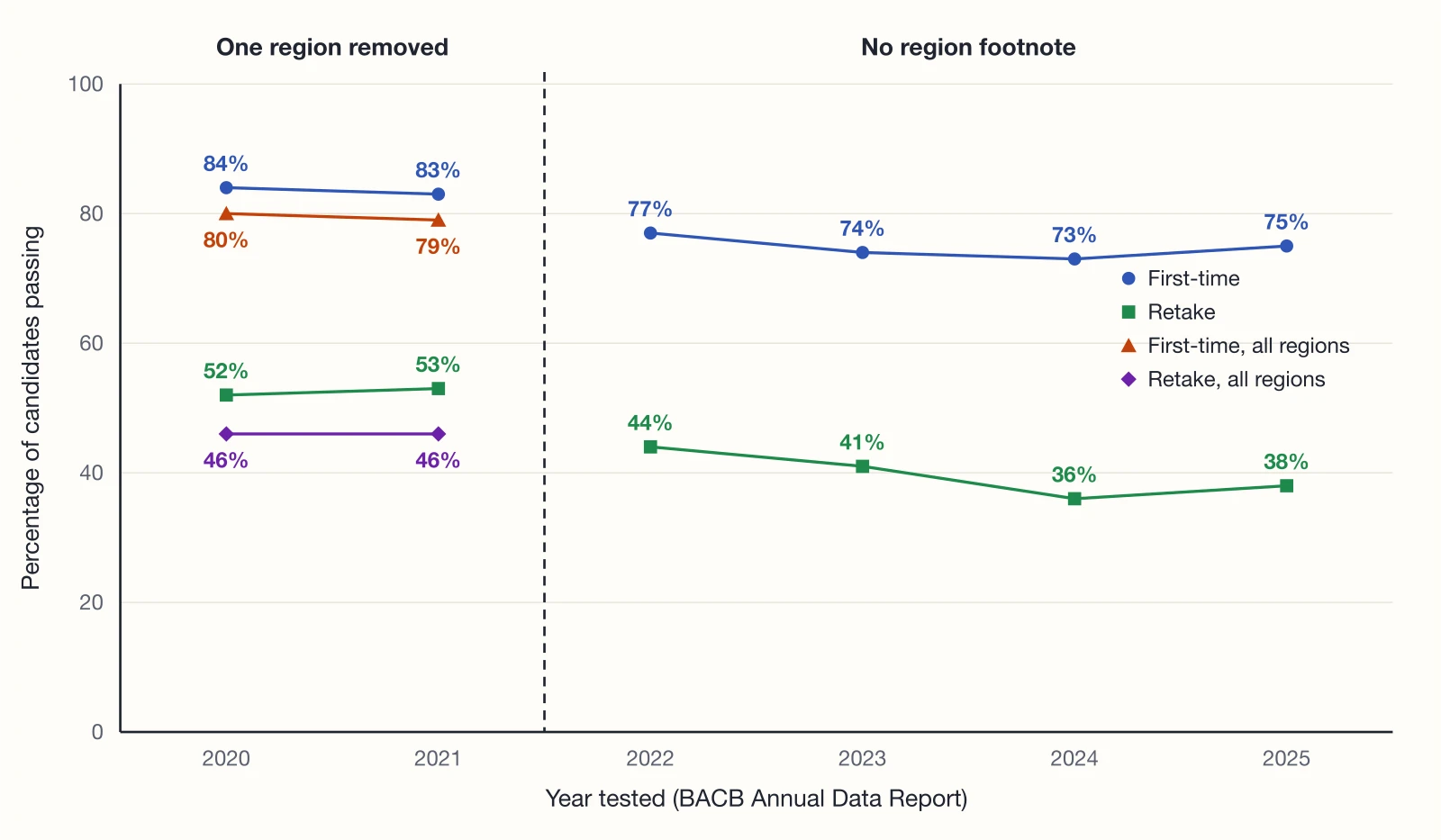
Figure 1. RBT exam pass rates, 2020 to 2025. Real data from the BACB Annual Data Report; graph by Praxis Notes. The dashed line marks where the BACB’s footnote about removed data stops.
Four things stand out on this line graph:
- The first-time fall depends on the baseline. The BACB’s reported 2020 and 2021 figures (84% and 83%) leave out a region it removed as “anomalous RBT-related activity”; with that data put back they read 80% and 79%. The BACB does not name the region or say what happened there after 2021. Our reading: the only clearly comparable run is 2022-2025, 77% to 75%.
- The retake rate fell further. It went from 46% across all regions in 2020 and 2021 to 38% in 2025, with a low of 36% in 2024.
- The number tested more than doubled. Total candidates rose from 78,684 in 2022 to 164,015 in 2025, and first-time candidates rose 87%.
- 2025 was slightly better. Both rates rose 2 points from 2024. One year is not a trend, so it does not show the fall has ended.
Reading a graph this way is also on the exam: task A.7 of the RBT Test Content Outline (3rd ed.) is identifying trends in graphed data, and Learn has a lesson on identifying trends in graphs.
Why did the RBT pass rate fall?
Part of the reported fall is a data break in 2020-2021. A change in who sits the exam is one plausible cause of the rest. The BACB has not published a reason, so this section is our reading of its data and rules, not a BACB statement.
- Part of it is the data break. The two highest first-time figures come from years with a region removed, so the size of the early drop depends on which figure you use.
- More candidates did not raise the bar. The passing score is criterion-referenced, and the BACB says “your performance on the examination is not dependent on the performance of those taking the examination with you”.
- The outline did not change. The exam was based on the RBT Task List (2nd ed.) from November 1, 2019 until the 3rd edition began on January 1, 2026, so all six years in the table cover the same edition.
- Who is testing has probably changed. Volume grew quickly, and first-time pass rates differ widely between training providers (see below). If more candidates came through routes with lower rates, the exam-wide rate would fall with no change to the exam. The BACB’s reports cannot confirm this.
- A passing-score change cannot be ruled out. The BACB does not publish the score, so nobody outside it can check. It says the modified Angoff method sets “the passing score for each base examination form” and that new base forms are created “approximately every five years or whenever there is a significant change to the examination content”.
Why do retake candidates pass less often than first-time candidates?
Retake candidates pass less often because every one of them has already failed the exam at least once, and the retake count may include repeat attempts by the same people. The BACB gives no reason, so this is our reading.
The BACB’s table says “candidates tested” and does not say whether someone who retakes three times counts once or three times. In 2025 there were 54,674 retakes against about 27,300 first-time fails, or two for each. The table does not settle the question: people who failed in 2024 can retake in 2025 too, and the 2024 and 2025 first-time fails together are about 51,800. The count is high enough that repeat attempts may be included. So 38% is best read as the result of a retake sitting, not the chance that someone who failed will eventually pass.
The totals point to a better outcome than 38% suggests:
| Year | Retakes as share of all tested | Estimated retake passes | Estimated first-time fails | New RBTs certified | New RBTs per 100 first-time candidates |
|---|---|---|---|---|---|
| 2022 | 26% | 9,000 | 13,400 | 53,146 | 91 |
| 2023 | 29% | 12,500 | 19,200 | 67,001 | 91 |
| 2024 | 34% | 16,900 | 24,500 | 82,681 | 91 |
| 2025 | 33% | 20,800 | 27,300 | 101,341 | 93 |
Our calculations from the BACB Annual Data Report. Estimates use the BACB’s rounded rates and are rounded to the nearest hundred. These are same-year comparisons, not a cohort followed over time: some people certified in a year first tested in an earlier one.
In 2025 there were about three retake passes for every four first-time fails, and about 93 new RBTs for every 100 first-time candidates. That second figure stayed at 91 to 93 for four years while the first-time rate moved between 73% and 77%. Our reading: most people who sit the RBT exam get certification in the end, though failing first costs time and another appointment fee.
How hard is the RBT exam?
The RBT exam is moderately hard: about three in four first-time candidates pass, well above the BCBA exam’s first-time rate, but one in four still does not. “Moderately hard” is our judgment from the BACB’s data. The RBT Handbook says the exam tests the outline “at a level consistent with that of an entry-level behavior technician”.
| 2025 exam | First-time pass rate | Retake pass rate |
|---|---|---|
| RBT | 75% | 38% |
| BCaBA (assistant-level) | 60% | 30% |
| BCBA | 51% | 23% |
Source: BACB Annual Data Report. The BCBA figures are explained in why half of BCBA candidates fail.
An entry-level exam can still catch people out. Our reading of why, from the format the BACB describes:
- It tests application. The retired sample questions in the RBT Handbook are short scenarios, so practice applying terms, not only reciting them.
- The clock is short. You get 90 minutes for 85 questions, about a minute each, and that time includes the terms and conditions and the tutorial.
- You can’t bring a calculator or scratch paper into the room. The RBT Handbook lists them as not permitted, though a dry-erase board is provided, and it does not mention an on-screen calculator. Data Collection and Graphing, which includes calculating rate, mean duration and percentage, is 13 of the 75 scored questions.
- The total score decides. All questions are equally weighted and your result rests on overall performance, so a strong domain can offset a weak one, though every domain counts toward your total.
- Older materials may be out of date. The exam has followed the 3rd edition since January 1, 2026, and the study guide lists the eight new tasks.
We found no BACB data on pass rates by domain, so any claim about which domain is hardest is opinion.
What percentage do you need to pass the RBT exam?
There is no published percentage: the BACB does not release a passing percentage or a required number of correct answers for the RBT exam. It sets the passing score with the modified Angoff method, and “the actual number of correct answers required to pass each examination may vary depending on the form”. Figures like “80% to pass” are study targets or guesses, not BACB rules. The RBT exam day guide covers scoring and results in more detail.
Does your 40-hour training provider change your odds?
Your 40-hour training provider is linked to different first-time pass rates, from 8.1% to 100% in 2025, but the BACB’s report does not show that the provider causes the difference. Candidates choose courses for many reasons, and some providers may simply serve better-prepared groups.
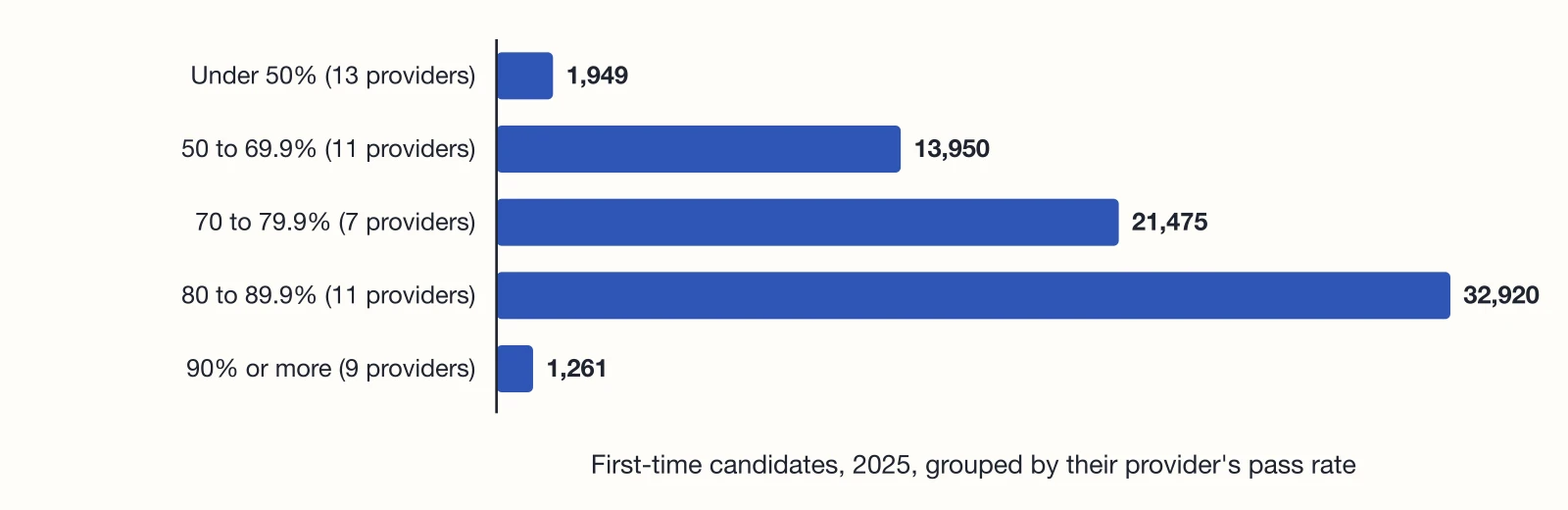
Figure 2. First-time candidates by their provider’s pass rate, 2025. Real data from the BACB’s RBT Examination Pass Rates for 40-Hour Training Providers (51 providers); grouping by Praxis Notes.
- Most candidates sit in the middle. About 76% of the candidates in the report trained with a provider whose rate was between 70% and 89.9%.
- The extremes are small, and one provider dominates each. The 9 providers at 90% or more had 1,261 candidates between them, and the 13 under 50% had 1,949. One provider accounts for most of the candidates in each band, and most of the others had fewer than 100, so their rates rest on few candidates.
- Size does not settle it. Among the 9 providers with 1,000 or more candidates, rates ran from 36.7% to 86.3%.
The report is not the whole picture. It covers publicly available providers with 10 or more first-time candidates, about 65% of 2025’s first-time total by our count, and it relies on the provider names applicants entered. The provider-by-provider list is in RBT 40-hour training compared by pass rate.
What do these pass rates mean for your exam?
Use these pass rates as a reason to prepare properly, not as a forecast of your result, because every pass rate on this page comes from the 2nd-edition exam. The 3rd edition began on January 1, 2026, and the RBT Handbook says “a new passing score is established when a significant change to the industry or examination content occurs (e.g., introduction of a new test content outline)”. The BACB has not published 2026 results, so nobody can yet say whether the new exam is harder or easier.
- Prepare to pass the first time. Each retake means another $45 appointment and at least 7 days of waiting, according to the RBT Handbook (updated October 2026).
- Follow a plan weighted by domain. The RBT exam study guide splits your hours by each domain’s share of the 75 scored questions.
- Check your readiness on the current outline. Work through the 43 tasks of the RBT outline, then set a 90-minute limit on RBT practice exams.
- If you fail, restudy everything. Your report lists the tasks you missed, but the BACB advises that “you should study all of the content”, because only a few items test each task. You have up to 8 attempts within 12 months of approval, and the RBT exam day guide has the retake steps.
Your next step is a timed attempt at the RBT practice exams, then use what you miss to decide how much more to study.
Sources
- Behavior Analyst Certification Board. BACB Annual Data Report (2020-2025 testing and certification data). Checked November 4, 2026. Web page
- Behavior Analyst Certification Board. Examination Information (historical RBT results and scoring). Checked November 4, 2026. Web page
- Behavior Analyst Certification Board. RBT Examination Pass Rates for 40-Hour Training Providers: 2025. Updated May 2026. PDF
- Behavior Analyst Certification Board. Registered Behavior Technician Handbook. Updated October 2026. PDF
- Behavior Analyst Certification Board. RBT Test Content Outline (3rd ed.). Updated September 2024. PDF
- Behavior Analyst Certification Board. BACB Newsletter, November 2019 (2nd-edition effective date). PDF
- Behavior Analyst Certification Board. BACB Newsletter, December 2023 (3rd-edition effective date). PDF
Sources last checked on November 4, 2026.
Reviewed by the Praxis Notes team on 2026-11-04.