BCBA Exam Pass Rate: Why Half Fail and What to Do After a Failed Attempt
BCBA exam pass rate: 51% first-time, 23% on retakes (BACB, 2025). Why retakers outnumber first-timers, fees, 2027 rules and a plan from your score report.
By Praxis Notes Team Editorial team
Published 15 min read
On this page
The BCBA exam pass rate was 51% for first-time candidates and 23% for retake candidates in 2025, according to the BACB’s annual data. The BACB reports the two groups separately and publishes no combined rate. Retake candidates are now the larger group, at 13,196 against 9,955, and 2025 was the first year of the 6th-edition exam.
This page is for BCBA candidates judging the exam and for anyone who has just failed it. It covers why retakers outnumber first-time candidates, what the January 1, 2027 rule change means for a retake, what each attempt costs, how to build a plan from your score report, and why so many first-time candidates fail. For what to study, start with the BCBA exam guide on Praxis Learn. RBT candidates have their own pass rate page, and more exam pages are in Study Guides & Exam Prep.
Why do BCBA retakers now outnumber first-time candidates?
Retake candidates have outnumbered first-time candidates every year since 2022, and they were 57% of everyone tested in 2025, according to the BACB’s annual data. The likely reason is arithmetic: about half of first-time candidates fail, about three in four retake candidates fail, and one approval allows up to 8 attempts. That explanation is our reading, not the BACB’s.
| Year (exam content) | First-time tested | First-time pass rate | Retakes tested | Retake pass rate | Retakes’ share of those tested | Newly certified |
|---|---|---|---|---|---|---|
| 2020 (4th ed.) | 6,583 | 66% | 6,166 | 31% | 48% | 6,243 |
| 2021 (4th ed.) | 12,107 | 60% | 11,301 | 28% | 48% | 10,460 |
| 2022 (5th ed.) | 7,179 | 55% | 8,575 | 24% | 54% | 5,980 |
| 2023 (5th ed.) | 8,255 | 56% | 10,450 | 23% | 56% | 6,948 |
| 2024 (5th ed.) | 9,911 | 54% | 11,780 | 25% | 54% | 8,164 |
| 2025 (6th ed.) | 9,955 | 51% | 13,196 | 23% | 57% | 8,021 |
Source: BACB Annual Data Reports, 2020-2025. The retakes’ share is our arithmetic. Checked November 4, 2026; 2025 is the latest year published.
This pattern sets the BCBA exam apart. Retakes were 33% of those tested on the RBT exam in 2025, by our arithmetic from the same BACB table, so on that exam first-time candidates are the clear majority of those tested. On the BCBA exam they are the minority.
- The pool keeps refilling. In 2025, about 4,900 first-time candidates and about 10,200 retake candidates did not pass, by our arithmetic from the BACB’s rounded rates. The BACB newly certified 8,021 people that year.
- “Half fail” describes first-time candidates only. 49% of them did not pass in 2025. Across both groups, 8,021 newly certified against 23,151 tested is about 35%. That 35% is our calculation, not a BACB figure.
- 54% is out of date. It is the 2024 first-time figure, though you may still see it quoted as current.
The 23% is not your chance on a second attempt. The BACB does not break the rate down by attempt number or say whether someone who retests twice in a year counts once or twice, and it does not publish how many candidates eventually pass.
Did the 6th edition make the BCBA exam harder?
One year of data cannot settle it. The first-time rate fell three points, from 54% to 51%, in the 6th edition’s first year, and Jim Carr, the BACB’s CEO, told Behavioral Health Business in March 2026 that “the most parsimonious explanation” includes that “it’s a new exam covering some different content”.
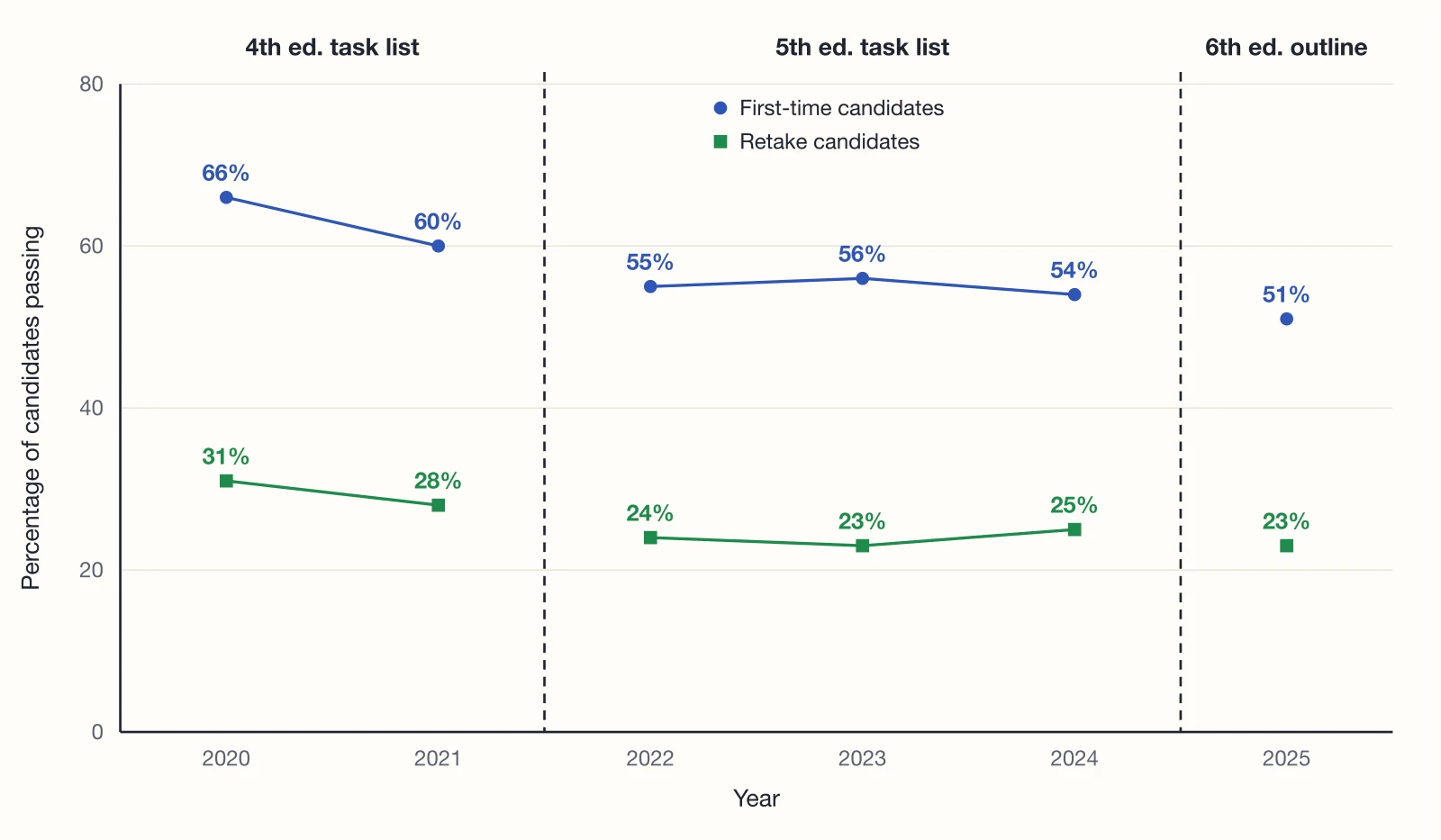
Figure 1. BCBA pass rates by year, split at each change in exam content. Real data from the BACB’s annual data reports; the graph is ours.
The BCBA exam has changed content twice in this period. All BCBA exams moved to 5th-edition content on January 1, 2022 and to the 6th-edition outline on January 1, 2025, and the BCBA Handbook says a new outline can bring a new passing score. Carr’s view, in the same interview: “You’re not really supposed to compare pass rates across eras of an examination.”
Our reading: 2022-2024 is a fair comparison, while 2025 is one year of data on a new exam. The 2021 spike to 12,107 first-time candidates came in the last year before the 2022 requirements, which we read as a rush to apply. The BACB has not said so.
How hard is the BCBA exam?
The BCBA exam is hard enough that 49% of first-time candidates did not pass in 2025, against 25% on the RBT exam. Our reading is that its breadth and pace add to that, though the clinicians quoted later on this page point to preparation rather than timing. It has 185 questions (175 scored, 10 unscored) on 104 tasks in 9 content areas, and you have 4 hours, according to the BCBA Handbook (updated October 2026). That works out to about 78 seconds a question, before taking off the terms and conditions, the tutorial and any breaks, all of which come out of your 4 hours.
Your result rests on your overall performance, not each content area, so no single content area has to be passed on its own. The BACB does not report your number correct or overall percentage, so a single percent-correct cut score on a prep site does not come from the BACB. The RBT pass rate page has more on how the BACB sets passing scores.
How many times can you retake the BCBA exam?
You can take the BCBA exam up to 8 times in total within the 2 years after your application is approved, with at least 30 days between attempts, according to the BCBA Handbook. That is one first attempt and up to 7 retakes. Your BACB portal shows your own deadline.
If you use all 8 attempts and still have time left in the 2 years, you must wait for the period to end before you can reapply.
What does the January 2027 rule change mean for BCBA retakes?
The January 1, 2027 change affects who can apply, not what the exam tests. Pathways 3 and 4 end and degree, coursework and fieldwork rules change, while the 2027 BCBA Requirements still name the exam based on the 6th-edition outline.
- Already approved, with time left. The BACB’s test is whether you applied and met the current requirements before that date. Our reading is that you keep testing under your approval until your window closes. The 2027 documents we read do not address this case directly, but in the 2022 change the BACB said an open authorization stayed “valid for its entire two-year duration”. Confirm your dates in your portal. Where you sit the exam can still change: the handbook authorizes testing sites in Australia only until January 1, 2027 and in Ontario only until July 1, 2026, and otherwise lists the US and Canada except Quebec. If you test in either place, find a site before you pay for a retake.
- Reapplying in 2027 or later. The BACB says anyone who has not applied and met the current requirements before January 1, 2027, “must meet the new requirements”. Our reading is that a reapplication on or after that date falls under the 2027 rules, with pathways 3 and 4 gone. In a fictional example, someone approved in March 2025 who has not passed by March 2027 would reapply under them, so confirm your dates in your portal. Australian residents will no longer be able to apply from January 1, 2027, and Ontario residents have not been able to since June 30, 2026; see the Jurisdiction section of the handbook.
- Not yet applied. How to become a BCBA covers who should file before the date and who can wait.
- A new outline mid-window. You must test under the new edition, with no exceptions. The BACB said in its January 2026 guidance that no change to the exam or outline was coming, and that updates can now happen separately from certification changes.
The latest BACB results are from 2025, before these rules apply, so no data yet shows what they do to pass rates.
How much does the BCBA exam cost, including retakes?
A first BCBA exam attempt costs $370 and each retake costs $265, according to the fee table in the BCBA Handbook (updated October 2026). You pay the BACB fees with each application, and Pearson VUE collects its $125 when you schedule.
| Attempt | BACB fee | Pearson VUE fee | Attempt total | Running total |
|---|---|---|---|---|
| First | $245 certification application | $125 | $370 | $370 |
| Second | $140 retake application | $125 | $265 | $635 |
| Third | $140 retake application | $125 | $265 | $900 |
| Eighth (the maximum) | $140 retake application | $125 | $265 | $2,225 |
The running totals are our arithmetic. These fees are for the exam only; coursework and fieldwork are separate, and how to become a BCBA covers them.
Other costs in the handbook:
- Moving an appointment: $0 at 31 days or more before the exam, $59 from 30 to 5 days, $69 from 5 days to 48 hours. Inside 48 hours you cannot move it and get no refund.
- Missing it or arriving more than 30 minutes late: you forfeit the Pearson VUE fee.
- Tax: Pearson VUE may add sales tax or similar where required.
- Veterans: those who qualify for the GI Bill can be reimbursed for exam fees, whether or not they pass.
What should you do right after failing the BCBA exam?
Download your score report first, then watch your BACB portal for the retake application, which appears within 48 hours, according to the BCBA Handbook. The steps:
- Log in to Pearson VUE and select “View Score Reports”. The BACB cannot view or download it for you.
- Look for the Examination Retake Application in your BACB portal. Submit it and pay the $140.
- Watch for your examination authorization email, which arrives within 48 hours of submitting, then schedule and pay Pearson VUE $125.
- Sit the exam no sooner than 30 days after your previous attempt.
Do not write down what you remember from the exam. The handbook bans “storing or disclosing examination questions” before, during or after the exam, and bans “reconstruction” of questions or content for other people, organizations or study groups. Violations can block you from retesting. Exam results cannot be appealed, though testing-site problems such as noise or long screen-load times can be, within 7 days.
How do you turn a BCBA score report into a retake plan?
Start from the questions you missed in each content area, not the lowest percentages, and keep every domain in the plan. A failing BCBA report shows the percentage correct and the total questions in each content area, where an RBT report lists tasks instead.
The BACB also warns that “you should study all of the content”, because each task gets few items, so the report may not show what you really understand, and studying only your weak areas can cost you in others.
This is our method, not a BACB rule. No study has tested the numbers, so adjust them to your time.
- Find the missed questions. For each domain, multiply its questions by the share you missed.
- Set the hours. Give each domain 1 hour per missed question plus 2 hours. The 2 hours keep every domain in the plan, as the BACB advises.
- Scale to your time. If you have fewer hours, cut every domain by the same share.
Fictional example: the percentages below are invented for one made-up candidate. The question counts come from the BCBA Test Content Outline (6th ed.). We worked from the BACB’s description of the report rather than a real one, so use the totals printed on yours if they differ.
| Domain | Questions | % correct (fictional) | Questions missed | Study hours |
|---|---|---|---|---|
| A. Behaviorism and Philosophical Foundations | 8 | 75% | 2 | 4 |
| B. Concepts and Principles | 24 | 71% | 7 | 9 |
| C. Measurement, Data Display, and Interpretation | 21 | 67% | 7 | 9 |
| D. Experimental Design | 13 | 62% | 5 | 7 |
| E. Ethical and Professional Issues | 22 | 77% | 5 | 7 |
| F. Behavior Assessment | 23 | 65% | 8 | 10 |
| G. Behavior-Change Procedures | 25 | 64% | 9 | 11 |
| H. Selecting and Implementing Interventions | 20 | 60% | 8 | 10 |
| I. Personnel Supervision and Management | 19 | 74% | 5 | 7 |
| Total | 175 | 56 | 74 |
Domain names link to the matching practice set on Praxis Learn.
Domain H has the lowest percentage, but Domain G costs more questions because it is larger. Domain D looks weak at 62% but cost only 5 questions, the same as Domain E at 77%. Sorting by missed questions rather than percentage is the main thing this table changes.
Change how you practice
- Practice at exam pace. About 46 questions an hour gets you through 185 in 4 hours with nothing to spare. Aim for 50 an hour, which leaves about 18 minutes for the start-up screens, breaks and review. Jessica Jones of BrightBridge ABA told Behavioral Health Business she has heard from test-takers who ran out of time, though she does not see timing as the main problem. The BACB gives no timing figures that we could find.
- Use a dry-erase board. The handbook says the testing center provides one, and you cannot bring notes into the room.
- Explain every miss. For each wrong answer, write why the right answer fits the scenario and why yours does not. Name the distinction, for example a motivating operation versus stimulus control, when a functional analysis fits, which differential reinforcement procedure applies, what interobserver agreement tells you about the data, or what a multiple-baseline design can show.
- Take cases to a mentor. If your fieldwork was thin in a domain, ask a supervisor to talk through real-world style cases with you, with no client details. Domains E and I alone are 41 of the 175 scored questions. Our guide to the Ethics Code for Behavior Analysts covers the code behind Domain E.
- Ask about accommodations. If you may qualify, send the BACB’s accommodation request early. Review typically takes 10-14 days, longer if it asks for more documents.
Choose the date with the fee table in mind
Do not book day 30 by default. The fictional plan above needs 74 hours, so at about 9 hours a week it takes roughly 8 weeks. Our suggestion is to book 9 weeks out, then check your progress 31 days before the exam. That is the last point where moving it is free.
No practice score can tell you that you are ready, because the BACB does not publish a percentage that passes. Set your own test instead: finish a timed set at 50 questions an hour, and see your three largest-loss domains improve in new questions, not ones you have already seen.
Why do so many first-time BCBA candidates fail?
The BACB has not named a single cause, but its data points to low pass rates at the largest programs, and its CEO also points to the new exam. Clinicians quoted in the trade press add preparation.
- Large programs. The 10 largest programs had 5,446 of the 9,955 first-time candidates (54.7%) and a mean program pass rate of 42.9%, according to the BACB’s 2025 university report. The report says they had “a considerable influence” on the 51%.
- Preparation. Michelle Hascall, director of clinical excellence at Cortica Autism Care, told Behavioral Health Business that “we are not doing a great job of preparing people to be BCBAs”, and that weak applied experience “shows up when they’re asked to generalize concepts in the exam”. That is one clinician’s view, not BACB data.
Large programs do not explain the whole figure. Weighting the 10 programs by their candidates gives about 47% passing, which leaves about 56% for the other 4,509 first-time candidates. Those are our calculations from the BACB’s rounded rates. Taking the largest programs out lifts the national rate by about five points, and roughly 44% of everyone else still did not pass.
How should you read a university’s BCBA pass rate?
Read a program’s pass rate as a rough chance for its own first-time candidates, not as a score against the national figure. The BACB says a 60% rate “would roughly indicate a 3-in-5 chance of passing”, and recommends that you “do not compare a training program’s pass rate with the overall examination pass rate”. Its 2025 report adds that pass rates “are not rankings, endorsements, or guarantees” and covers 204 programs and 8,558 of the 9,955 first-time candidates.
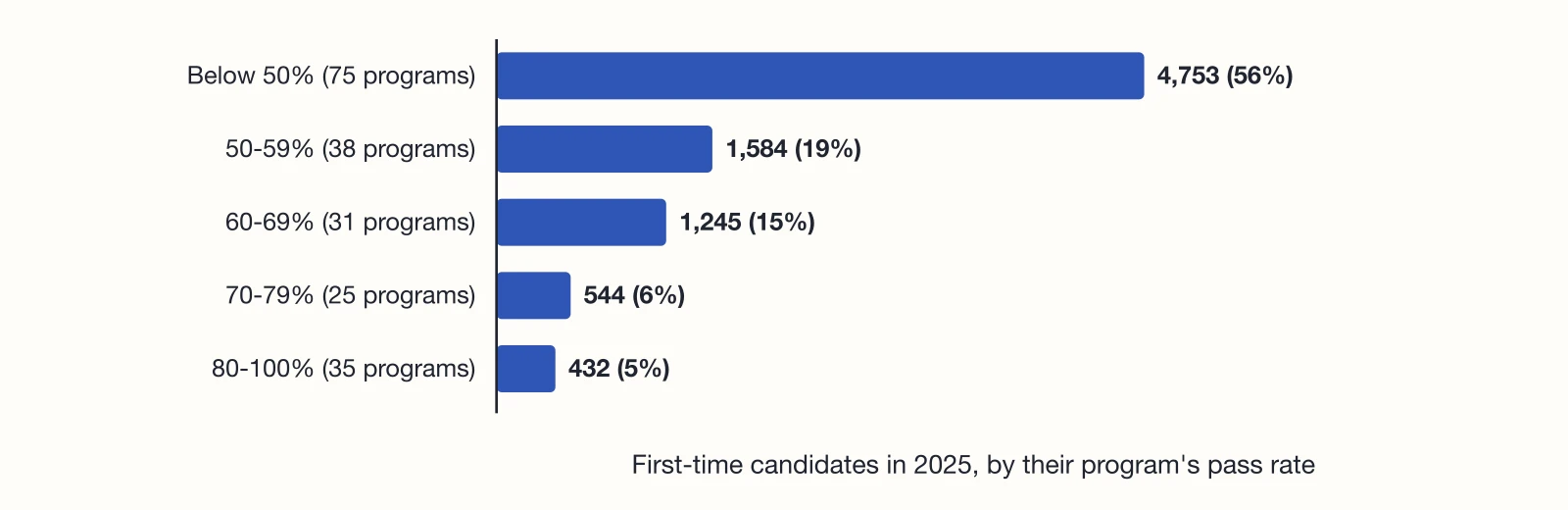
Figure 2. First-time candidates in the BACB’s 2025 report, grouped by program pass rate. Real BACB data; the grouping and percentages are our count of its full program list.
Most candidates in the report trained where fewer than half passed. By our count, 75 of the 204 programs were below 50% and held 4,753 of the 8,558 candidates, while the 35 programs at 80% or higher held 432.
Accredited programs did better, with a caveat. ABAI-accredited programs had a mean pass rate of 79.3% against 53.2% for the rest, according to the same report. That mean counts every program equally, and we add up only 295 candidates in those 25 programs, about 3% of the report’s total, so a small program can sit at 100% on six people. The accreditation gap also matters for planning: from January 1, 2032, the accredited-degree pathway will be the only route to BCBA certification.
To check a large program’s first-time rate, these are the 10 largest in the BACB’s 2025 report, in order of size, not a ranking. The rates cover first-time candidates only.
| Program | First-time candidates | Pass rate |
|---|---|---|
| Arizona State University, Special Education ABA | 1,197 | 44% |
| Ball State University, Applied Behavior Analysis | 1,026 | 50% |
| Capella University, Applied Behavior Analysis | 928 | 41% |
| Florida Institute of Technology, ABA Certificate | 807 | 69% |
| National University, M.S. in ABA | 424 | 35% |
| University of West Florida, Center for Behavior Analysis | 293 | 43% |
| Purdue University Global, M.S. ABA | 285 | 46% |
| ABA España/Universidad de Cádiz, Máster | 172 | 20% |
| Purdue University Global, Graduate Certificate in ABA | 168 | 43% |
| University of Cincinnati, Masters/Graduate Certificate | 146 | 38% |
If you failed, your program’s rate does not change your plan. Start with your score report, then work through the BCBA practice sets on Praxis Learn in the order of your largest losses, using the BCBA task list to check coverage.
Sources
Checked on November 4, 2026:
- BACB, Annual Data Reports, 2020-2025.
- BACB, BCBA Examination Pass Rates for University Training Programs, 2025, updated October 2026.
- BACB, University Examination Pass Rates.
- BACB, BCBA Handbook, updated October 2026.
- BACB, Examination Information.
- BACB, BCBA Test Content Outline (6th ed.).
- BACB, 2027 BCBA Requirements, updated February 2026.
- BACB, Guidance for Meeting the BCBA Requirements During the 2027 Transition, updated January 2026.
- BACB, Recent and Upcoming Changes.
- BACB, The 2022 Transition: What You Need to Know.
- Ashleigh Hollowell, What’s Driving BCBA Exam Pass Rates to Historic Lows, Behavioral Health Business, March 30, 2026 (trade press, subscriber story, used for interview quotes only).
Reviewed by the Praxis Notes team on 2026-11-04.