Ethics Code for Behavior Analysts Explained: Sections and Self-Reporting
BCBA ethics code explained: free one-page map of 6 sections and 85 standards, BCBA vs RBT code differences, 30-day self-reporting and BACB violation data.

By Praxis Notes Team Editorial team
Published 14 min read
On this page
The BCBA ethics code is the BACB’s Ethics Code for Behavior Analysts, which has bound BCBAs, BCaBAs and applicants since January 1, 2022. It sets out four core principles and 85 standards in six sections, and the current PDF is dated August 2024. The RBT Ethics Code (2.0) is a separate document.
This page is for BCBA trainees and working behavior analysts who want the whole code in one view: a verified section map, the code’s few hard numbers, the mix-ups with the RBT code and the BACB’s own violation data. The same document is also called the BACB code of ethics, the BCBA code of ethics or the ABA ethics code, and there is one current code, not several. It paraphrases, so check the full text for exact wording. More study pages are in Study Guides & Exam Prep.
The BACB says it cannot interpret ethics requirements (BCBA Handbook, updated 10/2026, p. 45), so “our reading” below marks our interpretation, not the BACB’s. This is not legal advice; for a specific situation, check your licensure board’s rules or ask an attorney.
Who has to follow the BCBA ethics code?
Everyone who holds BCBA or BCaBA certification, and everyone who has completed an application for either, must follow the code, according to its scope section (p. 3). The BACB’s Ethics Codes page also lists Authorized Continuing Education providers. It covers all professional activity, from direct services and supervision to training, management and research, in person or by phone, text or video.
Four limits are worth knowing:
- Trainees. The BACB has no jurisdiction over trainees, so it cannot process a Notice against you until you become an applicant (Code-Enforcement Procedures, 04/2026, p. 4), which happens once exam application fees are paid. But the Handbook (pp. 19, 67) says trainees agree to abide by the code and makes your supervisor responsible for ensuring you do. A trainee who holds RBT certification still answers to the RBT code.
- Your supervisor. Standard 4.04 makes supervisors accountable for trainees’ professional activities within the supervisory relationship, and the Handbook (p. 45) requires them to review the code with you. If you are working toward BCBA certification, you will meet it long before you apply.
- Companies. The code says the BACB has no separate jurisdiction over organizations, and its reporting page confirms you cannot report a company, only a certified person or applicant.
- Personal life. The code does not reach personal behavior unless that behavior “clearly poses a potential risk” to the health and safety of clients, stakeholders, supervisees or trainees (p. 3).
Not knowing a standard is no defense, the code states (p. 5). It also shows up on the exam: Ethical and Professional Issues is 22 of the 175 scored BCBA questions, or 13%, in the BCBA Test Content Outline (6th ed.). Before you sit it, see the BCBA exam pass rate. After certification, 4 of your 32 CEUs per 2-year cycle must be in ethics (Handbook, p. 43).
What are the four core principles?
The four core principles are benefit others; treat others with compassion, dignity and respect; behave with integrity; and ensure your own competence (Code, p. 4). In our paraphrase:
- Benefit others: put client welfare and rights first, avoid harm, watch long-term effects and resolve conflicts of interest.
- Compassion, dignity and respect: treat people equitably, protect privacy and support clients’ choices.
- Integrity: be honest, follow through, correct your errors and uphold BACB and other regulatory requirements.
- Competence: stay within your scope, keep learning and stay current on what could harm clients.
The Learn lesson on core ethical principles teaches these for exam task E.1.
How do the principles differ from the standards?
The principles are what behavior analysts “should strive to embody” and the standards are the specific rules built on them (Code, p. 4). You use the principles to interpret and apply the standards, and a Notice of Alleged Violation concerns alleged violations of standards. The BACB’s Ethics Codes page says enforcement covers “ethics requirements,” a term it uses for all the elements in the code, so do not read the principles as outside enforcement (our reading).
Some summaries call the principles aspirational and the standards enforceable. The code does not use either word, so treat that as shorthand (our reading). The standards are also not exhaustive: the code says conduct missing from the list is not automatically ethical or unethical (p. 5).
What are the six sections of the BACB ethics code?
The six sections cover your responsibility as a professional, in practice, to clients and stakeholders, to supervisees and trainees, in public statements and in research (Code, p. 3). This map groups each section’s standards by topic, in our words:
| Section | Standards | Count | What is inside |
|---|---|---|---|
| 1. Responsibility as a Professional | 1.01-1.16 | 16 | 1.01-1.03 truthfulness, law, accountability; 1.04-1.06 role and competence; 1.07-1.10 culture, discrimination, harassment, bias; 1.11-1.14 relationships, gifts, power; 1.15-1.16 responding, self-reporting |
| 2. Responsibility in Practice | 2.01-2.19 | 19 | 2.01-2.02 effective, timely services; 2.03-2.05 confidentiality, records; 2.06-2.07 billing, fees; 2.08-2.11 communication, families, colleagues, consent; 2.12 medical needs; 2.13-2.19 assessment, intervention, risk, data |
| 3. Responsibility to Clients and Stakeholders | 3.01-3.16 | 16 | 3.01-3.03 best interest and mandated reporting, stakeholders, accepting clients; 3.04-3.05 agreements; 3.06-3.09 other providers, third-party contracts; 3.10-3.13 confidentiality limits, records, advocacy, referrals; 3.14-3.16 continuity, discontinuing, transitions |
| 4. Responsibility to Supervisees and Trainees | 4.01-4.12 | 12 | 4.01-4.03 rules, competence, volume; 4.04-4.05 accountability, records; 4.06-4.07 how you supervise, diversity; 4.08-4.10 feedback, delegation, self-evaluation; 4.11-4.12 continuity, ending supervision |
| 5. Responsibility in Public Statements | 5.01-5.11 | 11 | 5.01-5.02 rights, confidentiality; 5.03-5.04 truthful statements, including others’ statements about you; 5.05-5.06 intellectual property, nonbehavioral services; 5.07-5.09 testimonials; 5.10-5.11 social media, digital content |
| 6. Responsibility in Research | 6.01-6.11 | 11 | 6.01-6.03 laws, review, research during services; 6.04-6.05 consent, confidentiality; 6.06-6.07 competence, conflicts; 6.08-6.09 credit, plagiarism; 6.10-6.11 data retention, accuracy |
Download the one-page BCBA ethics code section map (PDF). It is free, with no sign-up, and adds the hard numbers and RBT mix-ups below.
How many standards are in the BACB ethics code?
The Ethics Code for Behavior Analysts has 85 numbered standards: 16, 19, 16, 12, 11 and 11 across its six sections. We counted them one by one in the August 2024 PDF on November 4, 2026. You may see other totals online, such as 96, but the PDF does not support them.
Which standards contain a hard number?
Only four fixed figures appear in the 85 standards, by our scan of the PDF:
| Figure | Standard | The rule |
|---|---|---|
| More than $10 | 1.12 | No gifts above this value to or from clients, stakeholders, supervisees or trainees. The standard also calls a gift acceptable if it is an infrequent expression of gratitude with no financial benefit to the recipient; how that interacts with the $10 limit is not spelled out (our reading: stay at or under $10) |
| 2 years | 1.14 | Minimum wait before a romantic or sexual relationship with a former client or stakeholder |
| 6 months | 1.14 | Minimum gap after a romantic or sexual relationship before accepting that person as a supervisee or trainee |
| 7 years | 4.05 | Minimum retention for supervision documentation |
The 7 years in 4.05 applies to supervision records. Standard 2.05, on documentation generally, gives no figure and points to the laws, contracts and funder rules that apply to you, so check those for client records (our reading).
Which standards tell you to document?
By our count, 17 of the 85 standards use near-identical wording that tells you to document all actions taken and the eventual outcomes: 1.10, 1.11, 2.06, 2.07, 2.10, 2.19, 3.03, 3.08, 3.14, 4.12, 5.04, 5.06, 5.07, 5.08, 5.09, 5.10 and 5.11. Most describe a situation that has gone off course, such as a billing error or an organization breaking a testimonial rule. The code’s application section (p. 5) adds the same duty whenever you address a potential violation.
How do you cite the ethics code in APA style?
Use the reference the code prints on its first page: Behavior Analyst Certification Board. (2020). Ethics code for behavior analysts. https://bacb.com/wp-content/ethics-code-for-behavior-analysts/
Has the BACB ethics code changed since 2022?
No new edition has replaced it: the code in force today is the one that took effect on January 1, 2022, and the BACB’s own citation for it still reads 2020. So searches for a “BACB ethics code 2024”, “2025” or “2026” all lead to this document.
The current PDF’s footer says “Updated 08/2024”, but the wording did not change in any way we could find. We compared its extracted text with an archived March 2022 copy on November 4, 2026. Every principle, glossary entry and standard matched. Apart from the footer date, only a copyright line on the first page differed. A text comparison would not show layout changes.
The revision history on the BACB’s Ethics Codes page lists one edit: adding the definition of “assent” to the glossary in September 2021. The same page asks you to check back periodically for current versions.
What changed from the old compliance code?
Five standards were added and five removed when the current code replaced the Professional and Ethical Compliance Code (PECC), according to the BACB’s crosswalk, which is now marked historical. The PECC dates from 2014 and took effect on January 1, 2016.
- Added: 2.02 Timeliness, 4.05 Maintaining Supervision Documentation, 4.07 Incorporating and Addressing Diversity, 5.01 Protecting the Rights of Clients, Stakeholders, Supervisees, and Trainees, and 5.10 Social Media Channels and Websites.
- Removed (old numbers): 5.05 Communication of Supervision Conditions, 6.01 Affirming Principles, 8.06 In-Person Solicitation, 9.05 Debriefing, and 10.04 Examination Honesty and Irregularities.
How is the BCBA code different from the RBT Ethics Code?
The Ethics Code for Behavior Analysts covers BCBAs and BCaBAs with 85 standards in six sections, while the RBT Ethics Code (2.0) covers RBTs with 29 standards in three sections. Both took effect on January 1, 2022. Only the RBT code carries the “2.0” label, so a “BCBA ethics code 2.0” does not exist in the BACB’s documents.
The numbering is an easy mix-up, because the same topic sits under a different number:
| Topic | Behavior analyst code | RBT code (2.0) |
|---|---|---|
| Self-reporting | 1.16 | 3.04 |
| Multiple relationships | 1.11 | 1.10 |
| Gifts over $10 | 1.12 | 1.11 |
| Romantic or sexual relationships | 1.14 | 1.12 |
| Protecting confidentiality | 2.03 | 2.08 |
| Restrictive or punishment-based procedures | 2.15 | 2.05 |
Two other differences matter in practice. RBT standard 3.04 states its 30-day self-reporting window in the standard itself, while 1.16 in the behavior analyst code leaves the deadline to the Handbook. And an alleged RBT violation can sometimes go to the Requirements Coordinator or supervisor rather than the BACB. For the RBT side, see the RBT Ethics Code 2.0 explained.
What does the code say about self-reporting?
Standard 1.16 says only that behavior analysts stay knowledgeable about and comply with the self-reporting requirements of relevant entities, such as the BACB, licensure boards and funders (Code, p. 10). The list of events and the deadline are in the BCBA Handbook (updated 10/2026, pp. 46-48), not in the code.
The Handbook requires critical events to reach the BACB no more than 30 days after you become aware of them. It names four kinds:
- Violations of ethics standards, including leaving a job without arranging continuity of services, a multiple relationship with a client or supervisee, or failing to keep appropriate client records.
- Health conditions and substance use disorders that directly affect your ability to provide services safely and competently, under the conditions the Handbook lists.
- Investigations naming you, a company you own or a company where you hold a primary role in the matter. Report when you learn of one, without waiting for it to end.
- Agreements and actions, such as an employer termination for an ethics violation, a settlement with a funder or certain court matters.
The BACB’s Self-Reporting page spells out the 30 days only for investigations and for agreements and actions. The Handbook applies it to all critical events and is dated October 2026, so we follow the Handbook. Some events do not need a report, including parking tickets and personal bankruptcy (p. 48). If you are unsure, the Handbook says “the best course of action is to self-report” (p. 46).
This page stops there on purpose. For what counts and how to file, use the BCBA self-reporting guide. For how it differs from reporting abuse or neglect to state agencies, read mandated reporting vs self-reporting.
What happens when someone reports a violation?
The BACB reviews a written Notice of Alleged Violation and decides mainly on the documents, because it typically does not act as an investigatory body (p. 1). The usual path:
- Raise it directly when that is safe. The code (p. 5) asks you to address a concern with the person when, after assessing the situation, it seems possible that this will resolve it without placing you or others at undue risk. Criminal activity or immediate risk of harm goes to the authorities first.
- Report to other bodies first when required. The BACB’s reporting considerations (03/2026) say that in states with licensure you report to the board before filing, and mandatory reporters go to the appropriate agency first.
- File the Notice. It must arrive within 6 months of the alleged violation or of learning about it, though staff can extend this in exceptional circumstances. It can run no more than 20 pages, must be redacted and needs clear supporting documents (Procedures, p. 4).
- The subject responds. Missing a BACB deadline leads to automatic suspension, published with the person’s name.
- The BACB routes the case. It can decline or defer it, or handle it through an Educational Memorandum, a Consent Agreement or a Disciplinary Review. Disciplinary action needs a preponderance of the documentation, meaning more likely than not (pp. 4-5).
- Consequences and appeal. Corrective actions such as mentorship are not published. Sanctions such as revocation, suspension, practice restriction and mandatory disciplinary supervision are. After a Disciplinary Review or summary action, the subject has 30 days to request an appeal, then another 30 days for documents; Consent Agreements and Educational Memoranda cannot be appealed (pp. 6-7).
Which ethics violations are most common?
Professionalism and integrity was the largest named category in the latest BACB count we could find, with 66 substantiated violations by BCBA and BCaBA certificants and applicants in 2019-2021, followed by failure to report or respond to the BACB (39) and improper supervision or delegation (22), according to its enforcement summary (updated 10/2024). These figures come from the 91 BCBA and BCaBA Notices processed through the Disciplinary System, many with more than one violation, and were decided under the old code; less serious matters handled through the Education System are not counted.
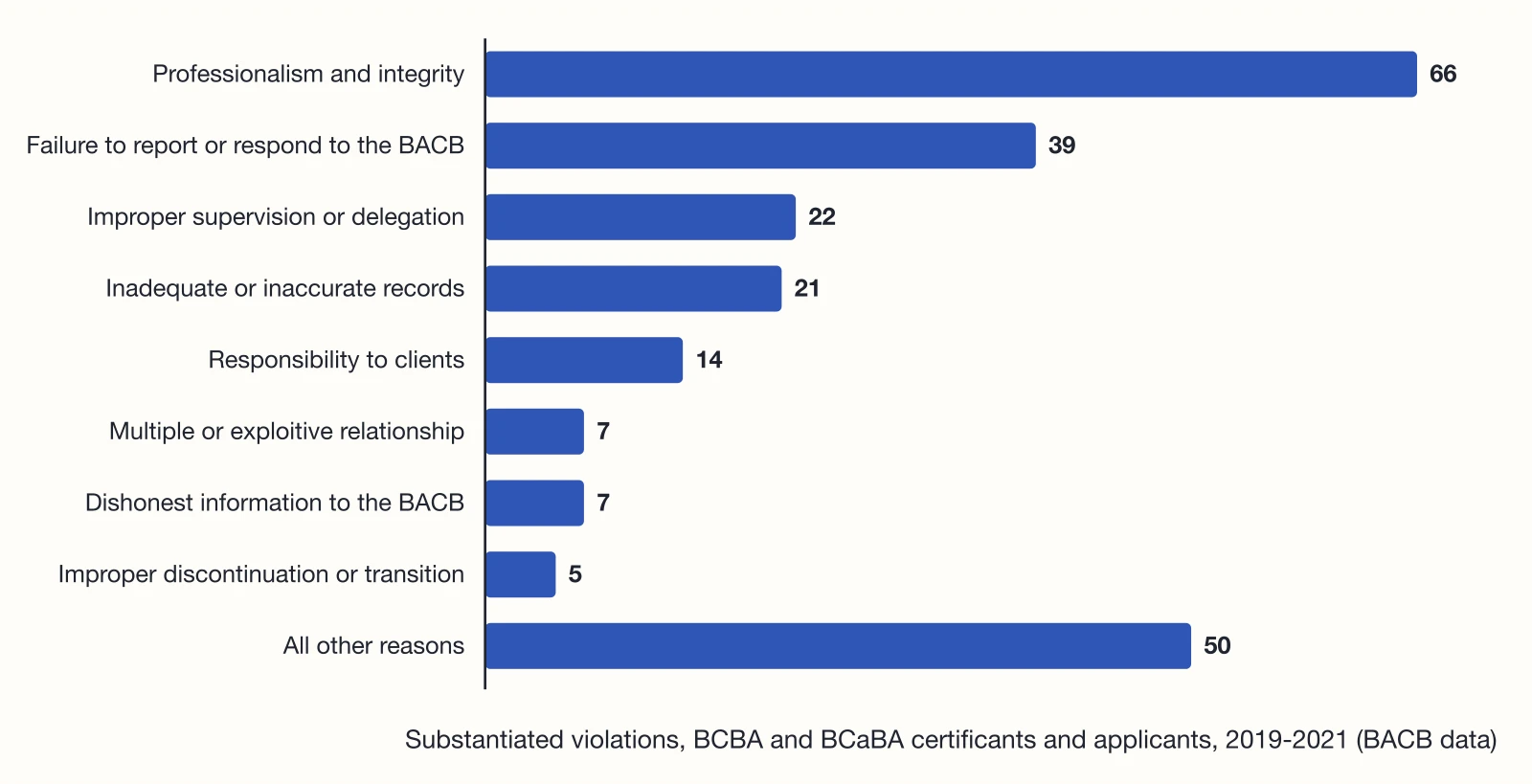
Figure 1. Substantiated violations by BCBA and BCaBA certificants and applicants, 2019-2021. Real data from the BACB’s enforcement summary, Table 2; labels shortened.
We could not find this breakdown under the current code, so we used the BACB’s crosswalk to show where each old category now sits. The mapping is ours:
| BACB category (2019-2021) | Count | Where it sits in the current code |
|---|---|---|
| Professionalism and integrity | 66 | 1.01-1.10, 2.08, plus the code’s introduction |
| Failure to report or respond to the BACB | 39 | 1.15, 1.16 |
| Improper or inadequate supervision or delegation | 22 | 4.01, 4.03, 4.06, 4.09 |
| Inadequate or inaccurate records | 21 | 2.05, 2.06 |
| Responsibility to clients | 14 | 1.15, 2.03, 2.04, 2.08, 2.11, 3.01, 3.04, 5.11 |
| Nonsexual multiple or exploitive relationship | 7 | 1.11, 1.12 |
| Dishonest information to the BACB | 7 | 1.01 |
| Improper discontinuation or transition | 5 | 3.14, 3.15, 3.16, 4.11, 4.12 |
| All other reasons | 50 | Not broken out |
Our reading: reporting, supervision and records together account for 82 of the 231 violations, and many of these look like process failures, though the summary gives no case detail. If you are new to the code, learn 1.15-1.16, 2.05-2.06 and Section 4 early.
How do several standards apply to one situation?
Real situations usually touch several sections at once, so read them together with the client’s interests first (3.01). This fictional example shows how, and the actions are our reading rather than BACB advice.
Fictional example. Jordan, a BCBA at a clinic, is told by the director to take over a client whose main need is feeding, an area Jordan has not trained in. The previous BCBA left with no transition plan. The parent offers a $25 gift card, and the marketing team wants to ask the parent to let them use a thank-you message in an ad.
| Issue | Standards | What Jordan does |
|---|---|---|
| Case outside Jordan’s competence | 3.03, 1.05 | Raises it with the director and documents the outcome; gets documented training or consultation, or refers |
| Feeding may have a medical cause | 2.12 | Makes sure medical needs are assessed, documents the referral and follows up |
| No transition plan | 3.01, 3.14, 3.16 | Protects continuity for the client now; raises it with the former BCBA if that seems safe and useful |
| $25 gift card | 1.12 | Declines it, or suggests a gift worth $10 or less, because the amount is over the limit and the gratitude sentence does not clearly lift it (our reading), and explains the limit to the family |
| Thank-you message in an ad | 5.07, 5.04, 5.02 | Tells marketing that testimonials from current clients or stakeholders can’t be solicited for ads; if the clinic goes ahead, makes reasonable efforts to fix it and documents them |
The code itself offers an 11-step decision process (pp. 5-6), from defining the issue and the risk of harm to evaluating the outcome, and says no single process fits every situation. Our 8-step ethical decision-making model is a shorter model built for exam scenarios.
Where can you practice BCBA ethics questions?
Practice in Praxis Learn, starting with the Ethical and Professional Issues practice exam. When a question exposes a gap, go to the Domain E lessons, especially multiple relationships, confidentiality, public statements and discontinuation and transitions. For the supervision standards, continue in Domain I.
Sources
All checked on November 4, 2026.
- Behavior Analyst Certification Board. Ethics Code for Behavior Analysts. 2020, effective January 1, 2022, updated 08/2024. PDF. Earlier version, updated 03/2022: archived copy.
- BACB. RBT Ethics Code (2.0). 2021, effective January 1, 2022, updated 08/2024. PDF
- BACB. Board Certified Behavior Analyst Handbook. Updated 10/2026. PDF
- BACB. Code-Enforcement Procedures. Version 04/2026. PDF
- BACB. Considerations for Reporting an Alleged Violation Against a BCaBA/BCBA. Updated 03/2026. PDF
- BACB. A Summary of Ethics Violations and Code-Enforcement Activities: 2019-2021. 2023, updated 10/2024. PDF
- BACB. Crosswalk for Behavior Analyst Ethics Codes. Updated 04/2023, historical document. PDF
- BACB. BCBA Test Content Outline (6th ed.). Updated 09/2024. PDF
- BACB web pages, no date shown: Ethics Codes, Self-Reporting, Reporting to the Ethics Department.
Reviewed by the Praxis Notes team on 2026-11-04.